
Friday, February 27, 2015


Tuesday, February 24, 2015

Monday, February 23, 2015
The Multilateral View
PML: What does it mean to adopt a Renaissance attitude?
DR: Tasso’s message is not specifically different from the message of the other great Renaissance writers and/or poets and/or artists. To make it as brief as possible, it would mean to pass from unilateral thinking (see the Enlightenment: “We are the light. Everything before us, or different from us, is darkness”) to a multilateral view. Since the universe, or even society, surpasses our faculties infinitely, we always need at least two opposite keys in order to approach it, and assume that both / all of them are significant.
To read Philip Murray-Lawson's interview with Dario Rivarossa, please click HERE.
DR: Tasso’s message is not specifically different from the message of the other great Renaissance writers and/or poets and/or artists. To make it as brief as possible, it would mean to pass from unilateral thinking (see the Enlightenment: “We are the light. Everything before us, or different from us, is darkness”) to a multilateral view. Since the universe, or even society, surpasses our faculties infinitely, we always need at least two opposite keys in order to approach it, and assume that both / all of them are significant.
To read Philip Murray-Lawson's interview with Dario Rivarossa, please click HERE.
 |
| Philip and Dario |
Wednesday, February 18, 2015
Trafika Europe Radio
Highbrow readers are already familiar with the Trafika Europe online literary journal. The project has advanced to a new stage as Radio Trafika Europe, a streaming online program dedicated to the discussion and performance of literature. Please click HERE for more details.

Thursday, February 12, 2015
Emanations V: The Deadline Approaches
International Authors and the editors of Emanations are happy to announce a Call for Submissions:
Emanations is an anthology series featuring fiction, poetry, essays, manifestos and reviews. The emphasis is on alternative narrative structures, new epistemologies, peculiar settings, esoteric themes, sharp breaks from reality, ecstatic revelations, and vivid and abundant hallucinations.
The editors are interested in recognizable genres—science fiction, fantasy, horror, political dystopia, satire, mystery, local color, romance, realism, surrealism, postmodernism--but the idea is to make something new, and along these lines the illusion of something new can be just as important. If a story or poem makes someone say, "Yes, but what is it?" then it's right for Emanations. Essays should be exuberant, daring, and free of pedantry. Length is a consideration in making publication decisions, but in keeping with the spirit of the project contributors should consider length to be “open.”
Our editorial vision is evolving. Contributors should see themselves as actively shaping the "vision" of Emanations.
Emanations: V
Emanations is an anthology series featuring fiction, poetry, essays, manifestos and reviews. The emphasis is on alternative narrative structures, new epistemologies, peculiar settings, esoteric themes, sharp breaks from reality, ecstatic revelations, and vivid and abundant hallucinations.
The editors are interested in recognizable genres—science fiction, fantasy, horror, political dystopia, satire, mystery, local color, romance, realism, surrealism, postmodernism--but the idea is to make something new, and along these lines the illusion of something new can be just as important. If a story or poem makes someone say, "Yes, but what is it?" then it's right for Emanations. Essays should be exuberant, daring, and free of pedantry. Length is a consideration in making publication decisions, but in keeping with the spirit of the project contributors should consider length to be “open.”
Our editorial vision is evolving. Contributors should see themselves as actively shaping the "vision" of Emanations.
Send files with brief cover note to Carter Kaplan:
Deadline: February 15, 2015
Contributors should place their name in the subject heading,
and they should include their name and contact information in the submitted file.
Contributors should place their name in the subject heading,
and they should include their name and contact information in the submitted file.
Please post questions, suggestions and ideas. The project is a collaborative effort, and as we share ideas the "vision" transforms, evolves, and grows. When we write stories and poems we hope to bring to bear the entire battery of modern and postmodern literary devices. More simply: we like good, strong writing. Our essays are incisive, precise, keen, challenging, and driven by the writer's desire to advance an intelligent audience's understanding of important subjects.
The Fine Print:
1) Submit files as follows: double space, Microsoft Word, Times New Roman size #11. Set Tabs for .2" and set spacing at 15. Use smart quotes. This will help reduce the workload as the editors format book for publication.
2) No simultaneous submissions (contributors should get fairly quick feedback anyway, especially if their submission meets our needs). Material that is obviously pulled from a file and has nothing to do with the goals of the anthology won't get any feedback beyond the initial acknowledgement.
3) Word count/line count? See details above. We're flexible, but contributors should be sensible when considering what they send in. A novella? Well, maybe, and so on.... Rules of thumb: a) Stories: very short to 20-30 pages. b) Poems: send in 5-10 pages. c) Essays: 5-10-30 pages.
4) Published as hard copy only—Emanations will be available on Amazon. Participants who make a substantial contribution of material, editorial work, or art will get a copy. It can take some time to get copies to contributors outside of North America. In the case of our first anthology, for example, it took forty-five days to get a copy to a contributor in to Nepal.
5) In the past, International Authors has made it possible for contributors to purchases copies “at cost” using coupon codes, and so on. International Authors is a consortium, and as such every contributor is a “member” or our community, and contributors are encouraged to help promote the anthology by sending review copies to newspapers, journals and relevant Web sites.
6) Copyright "reverts" to contributors upon publication. That is, after a piece appears in Emanations, the contributor can seek to publish their piece elsewhere. Contributors should understand that Emanations will remain for sale on Amazon indefinitely. All materials appearing in Emanations are under the exclusive copyright of the contributing writers and artists.
7) Note to poets: Please do not send poems as individual files. All poetry submissions should be sent as a SINGLE MircosoftWord file formatted in Times New Roman, size 11. Please submit three to ten pages.
Published By International Authors
Board of Editorial Advisors
Ruud Antonius, Netherlands/UK/Spain
Michael Beard, US
Jason W. Ellis, US
Cedric Cester, Spain
Mike Chivers, UK
Mack Hassler, US
Horace Jeffery Hodges, South Korea
Sushma Joshi, Nepal
Vitasta Raina, India
Elkie Riches, UK
Dario Rivarossa, Italy
Kai Robb, US
Stephen Sylvester, US

Sunday, February 8, 2015
Rivarossa Draws Cthulhu
Readers of Emanations are familiar with Dario Rivarossa's ability to intuitively grasp a poetic idea and swiftly set forth a corresponding image that is dynamic, emblematic, and enthralling.
Having read H. P. Lovecraft's "The Call of Cthulhu" in English for the first time--the story is featured in the new Fantasy Worlds anthology--Dario took out his pen and set to work. Contemporary renderings of the ancient malignancy tend towards romantic idealization and glorification--a being marked by Herculean physique, majestic wings, and an ontological aura that seems to radiate from a "higher" angelic substance... Dario rather sends us a figure closely following the descriptions offered by Lovecraft. It must be remembered that Cthulhu is indeed a foul beast, a noxious monstrosity properly representing the lowest regions of cosmic consciousness, embracing the base urgings of a "symptomatic" biological alchemy, the empty voids of deep space, and the nugatory significance of nascent elements in solitary and disparate disarray.

Thank you, Dario, for this heady reminder of the ghastly face of anti-human menace and primal evil in the actual form of which Lovecraft warns!
Having read H. P. Lovecraft's "The Call of Cthulhu" in English for the first time--the story is featured in the new Fantasy Worlds anthology--Dario took out his pen and set to work. Contemporary renderings of the ancient malignancy tend towards romantic idealization and glorification--a being marked by Herculean physique, majestic wings, and an ontological aura that seems to radiate from a "higher" angelic substance... Dario rather sends us a figure closely following the descriptions offered by Lovecraft. It must be remembered that Cthulhu is indeed a foul beast, a noxious monstrosity properly representing the lowest regions of cosmic consciousness, embracing the base urgings of a "symptomatic" biological alchemy, the empty voids of deep space, and the nugatory significance of nascent elements in solitary and disparate disarray.
Thank you, Dario, for this heady reminder of the ghastly face of anti-human menace and primal evil in the actual form of which Lovecraft warns!
Tuesday, February 3, 2015

Monday, February 2, 2015
Friday, January 30, 2015
Jerome Seckler interviews Henri Matisse
JS: There is a great deal of talk especially by hostile art critics that modern art is the equivalent of a fraud, that the artist is trying to put something over on the public. And although the public accepts modern art when incorporated into architecture, advertisements, posters, and even household articles, it still refuses to accept modern painting. What do think can be done to close this gap?
HM: Who occupies himself with that question? They are the painters and the critics. It began that way, criticized by everybody, but I didn’t bother myself about it. I said to myself, “when what I paint will be clearly expressed, everybody will understand.” I continued and I have been admitted.
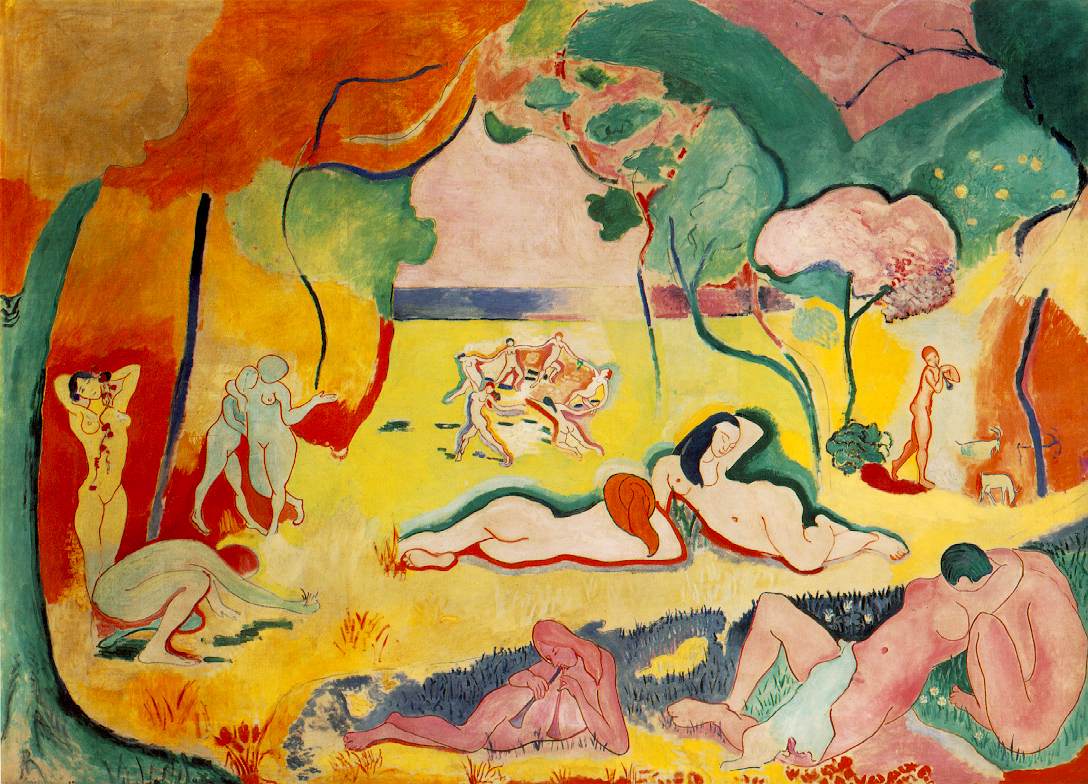 |
| Le bonheur de vivre (The Joy of Life) 1905-06 |
Tuesday, January 27, 2015
Sunday, January 25, 2015

Friday, January 23, 2015
Butterworth Show, Continued
Here's an announcement and related news from the Exhibition Centre for the Life and Use of Books in Manchester:
Please click HERE.
The announcement concludes: the "success of [the Butterworth show] has prompted research and further filming for a feature length documentary by Manchester-based artist Clara Casian, taking the innovative and experimental art and writing of the Corridor series as a starting point to examine the wider culture surrounding Savoy, and the lives and work of Butterworth’s peers."

Please click HERE.
The announcement concludes: the "success of [the Butterworth show] has prompted research and further filming for a feature length documentary by Manchester-based artist Clara Casian, taking the innovative and experimental art and writing of the Corridor series as a starting point to examine the wider culture surrounding Savoy, and the lives and work of Butterworth’s peers."

Thursday, January 22, 2015
Pictures from the Butterworth Show at Kent State University


Emanations I is visible in the last two photographs.
From Professor Hassler's introduction to the exhibit:
Please excuse my own voice initially to introduce these materials in the Michael Butterworth/Savoy Press Exhibit. The voice of Butterworth himself is on all the caption cards in the cases. It is a clever and witty voice that I characterize further below. But first, the radical nature of the materials, their European origins, and why we at Kent State should notice.
All American history is partially a product of invasions from Europe. I arrived at Kent to teach in the middle of the sixties, roughly the same moment as the Beatles invasion. I knew a lot about the radical and diabolic Lord Byron, about the French Revolution. But I was not prepared to be told by my friends about the Cleveland poet d.a. levy, who died defiantly in 1968. In fact, the country, the University all matured rapidly in the psychedelic sixties that climaxed for us at May 1970. Now 45 years later, I have completed my tenure of teaching—some radical and some conventional literature. I am fortunate to be able to introduce this bookish exhibit and “invasion” again of European radicalism and shall describe it in much more detail at my March 4 talk here. In the meantime, read carefully the captions by Butterworth in the cases. His voice is the voice of Swift, the voice of the French barricades in radical Paris, and of the diabolical Lord Byron (Lord Horror). He is clever, intense, informal; and this is solid literary history about banned books and about radical publishing. I think all of this helps to appreciate our very American history of radicalism inspired by our European roots—by this mixed and croaking speciation.
As we know, the frog is able to live underwater but is able, also, to sparkle in the sun. We hope for such amphibian complexity in what is exhibited here.
Wednesday, January 21, 2015
Nigerian Poet Seeks Critic
Nigerian poet Ebi Robert, whose poetry appears in Emanations: Foray into Forever, has contacted me seeking help with his play An Empty Kingdom. He is looking for a critic interested in writing a short introduction or afterword. Mr. Robert has provided me with the following prospectus:
The play is about the struggle of power between the people and the few. Set in the south-south, Niger Delta region of Bayelsa State of Nigeria, the play presents the struggle of governance between the people and a group of persons who believe in an oligarchical authoritarianism based on an ancient order of kingship by inheritance. The late King had no son, hence there was no one to continue the bloodline. The late King's uncle demands that he be made king, being the only surviving seed of the bloodline. The people refuse because nothing good has ever come out of the custom, save injustice. Thus they choose Tuaton, a man from another land who had lived with them. But the aristocrats refuse saying he is not a son of the soil. Thus, on and on, they struggle to influence the authorities and make one of their own King. Eventually, I plan to develop the concept into a trilogy. I currently seek someone to write a foreword for the play. Search the name "Ebi Robert" to contact me through facebook, or use my email: ebi [dot] fortune [at] yahoo [dot] com.Unfortunately, I am tied down and can't write the forward--anyway, not at this time. In the meantime, if someone can lend a hand here, please contact Mr. Robert as per his instructions. Incidentally, more of Mr. Robert's poetry will appear in Emanations V.
 |
| Ebi Robert |
Saturday, January 17, 2015
Quick Update
Receiving many fine submissions for Emanations V. A dystopian theme is evolving. The deadline is February 15. Please click HERE to view the Call for Submissions.
Editing Tasso's Il mondo creato (Creation of the World) Day 6. Should have it back to Dario and Salwa in a few days.
Meanwhile, more Tasso news (as always) from Dario: please click HERE.
Stay tuned.
Editing Tasso's Il mondo creato (Creation of the World) Day 6. Should have it back to Dario and Salwa in a few days.
Meanwhile, more Tasso news (as always) from Dario: please click HERE.
Stay tuned.
Tuesday, January 13, 2015

Friday, January 9, 2015


Thursday, January 8, 2015

Wednesday, January 7, 2015

Tuesday, January 6, 2015

Subscribe to:
Posts (Atom)


