Friday, April 8, 2016


Thursday, April 7, 2016
Emanations VI: Call for Submissions
International Authors and the editors of Emanations are happy to announce a Call for Submissions:
Emanations is an anthology series featuring fiction, poetry, essays, manifestos and reviews. The emphasis is on alternative narrative structures, new epistemologies, peculiar settings, esoteric themes, sharp breaks from reality, ecstatic revelations, and vivid and abundant hallucinations.
The editors are interested in recognizable genres—science fiction, fantasy, horror, political dystopia, satire, mystery, local color, romance, realism, surrealism, postmodernism--but the chief idea is to make something new, and along these lines the illusion of something new can be just as important. If a story or poem makes someone say, "Yes, but what is it?" then it's right for Emanations. Essays should be exuberant, daring, and free of pedantry. Stories of unusual travels might fit well in VI. Length is a consideration in making publication decisions, but in keeping with the spirit of the project contributors should consider length to be “open.”
Our editorial vision is evolving. Contributors should see themselves as actively shaping the "vision" of Emanations.
Emanations: VI
Emanations is an anthology series featuring fiction, poetry, essays, manifestos and reviews. The emphasis is on alternative narrative structures, new epistemologies, peculiar settings, esoteric themes, sharp breaks from reality, ecstatic revelations, and vivid and abundant hallucinations.
The editors are interested in recognizable genres—science fiction, fantasy, horror, political dystopia, satire, mystery, local color, romance, realism, surrealism, postmodernism--but the chief idea is to make something new, and along these lines the illusion of something new can be just as important. If a story or poem makes someone say, "Yes, but what is it?" then it's right for Emanations. Essays should be exuberant, daring, and free of pedantry. Stories of unusual travels might fit well in VI. Length is a consideration in making publication decisions, but in keeping with the spirit of the project contributors should consider length to be “open.”
Our editorial vision is evolving. Contributors should see themselves as actively shaping the "vision" of Emanations.
Send files with brief cover note to Carter Kaplan:
Deadline: September 1, 2016
Contributors should place their name in the subject heading, and they should include their name and contact information in the submitted file.
Contributors should place their name in the subject heading, and they should include their name and contact information in the submitted file.
this time. All proceeds from the sale of Emanations will support the efforts of International Authors to publish new voices from around the world. Contributors receive a copy upon publication.
Please post questions, suggestions and ideas. The project is a collaborative effort, and as we share ideas the "vision" transforms, evolves, and grows. When we write stories and poems we hope to bring to bear the entire battery of modern and postmodern literary devices. More simply: we like good, strong writing. Our essays are incisive, precise, keen, challenging, and driven by the writer's desire to advance an intelligent audience's understanding of important subjects.
The Fine Print:
1) Submit files as follows: double space, Microsoft Word, Times New Roman size #11. Set Tabs for .2" and set spacing at 15. Use smart quotes. This will help reduce the workload as the editors format book for publication.
2) No simultaneous submissions (contributors should get fairly quick feedback anyway, especially if their submission meets our needs). Material that is obviously pulled from a file and has nothing to do with the goals of the anthology won't get any feedback beyond the initial acknowledgement.
3) Word count/line count? See details above. We're flexible, but contributors should be sensible when considering what they send in. A novella? Well, maybe, and so on.... Rules of thumb: a) Stories: very short to 20-30 pages. b) Poems: send in 5-10 pages. c) Essays: 5-10-30 pages.
4) Published as hard copy only—Emanations will be available on Amazon. Participants who make a substantial contribution of material, editorial work, or art will get a copy. It can take some time to get copies to contributors outside of North America. In the case of our first anthology, for example, it took forty-five days to get a copy to a contributor in to Nepal.
5) In the past, International Authors has made it possible for contributors to purchases copies “at cost” using coupon codes, and so on. International Authors is a consortium, and as such every contributor is a “member” or our community, and contributors are encouraged to help promote the anthology by sending review copies to newspapers, journals and relevant Web sites.
6) Copyright "reverts" to contributors upon publication. That is, after a piece appears in Emanations, the contributor can seek to publish their piece elsewhere. Contributors should understand that Emanations will remain for sale on Amazon indefinitely. All materials appearing in Emanations are under the exclusive copyright of the contributing writers and artists.
7) Note to poets: Please do not send poems as individual files. All poetry submissions should be sent as a SINGLE MircosoftWord file formatted in Times New Roman, size 11. Please submit three to ten pages.
Published By International Authors
Board of Editorial Advisors
Ruud Antonius, Netherlands/UK/Spain
Michael Beard, US
Jason W. Ellis, US
Cedric Cester, Spain
Mike Chivers, UK
Sushma Joshi, Nepal
Vitasta Raina, India
Elkie Riches, UK
Dario Rivarossa, Italy
Dario Rivarossa, Italy
Wednesday, April 6, 2016
From Victor Hugo's Bestiary

The above image is Dario Rivarossa's interpretation of the octopus which confronts the protagonist in Victor Hugo's novel The Toilers of the Sea (see Highbrow April 1 for related discussion). The anatomically incorrect mouth (not a parrot beak) is true to Hugo's description, which, as Dario explains, is replete with scientific errors and fanciful assumptions. To read more on the matter, please click HERE.
Tuesday, April 5, 2016
Vitasta Raina on "Smart Urban Futures: The Liveable City of New India"
International Authors editor and author of the novella Writer's Block, Vitasta Raina has recently written on the psychological fragmentation of the contemporary Indian urban landscape. According to Ms. Raina, this fragmentation represents a key challenge to creating a new (and needed) urban plan--a plan that, she believes, must be central to Modern India's search for identity. I should add that her analyses of India's contemporary urban scene foreshadows larger issues that, in future, we should expect to see globally:
To read more of Ms. Raina's analyses and solutions for India's architectural and urban planning challenges, please click HERE.
The instability of identities demonstrated in the dichotomies of rural vs. urban, public vs. private, eastern vs. western, formal vs. informal, realty vs. architecture, politico-economics vs. grass root societies, etc. have created divisions and segregations within the urban realm making cities unsafe experiences for the mass of inhabitants.
Our cities have thus emerged as non-places in the grey areas between accident and design, between ethnicity and genderlessness, being led by forward thinkers motivated by tradition. The dynamics of contemporary Indian urbanism, the physical needs and social characteristics of urban Indian societies and the interactions of the inhabitants with the built-environment has essentially never been defined.Complicating the situation, increases in population "could lead to a collapse of Urban India, even before it has fully risen."
To read more of Ms. Raina's analyses and solutions for India's architectural and urban planning challenges, please click HERE.
 |
| Vitasta Raina |
Saturday, April 2, 2016
Tasso on the Aesthetics of Horror
From Creation of the World, Day 5: 1222-35
As a painter, who portrays the pallorand bleakness of a dead body, adorninga bloodless face with the hues of death,also adds there horrid beasts and frighteningmonsters, and verisimilar ones at that:though, as true-to-life, he may frighten you,the mere illusion of those painted featuresand his craftsmanship can delight you;so, by means of these colors and lightsof poetical style, together with theseshadows of poetry, I create dreadfulshapes, and I thus try my best to pleasethe most sublime minds, and from deep horrordraw such delight that satisfies the more wise.
A footnote engages these ideas:
Among the “manifestos” we have already come across, this one is the most radically Tassean. Cf. Gerusalemme Liberata 1, stanza 3, but capsizing it: there, beautiful descriptions aimed at attracting readers and making them “drink” (that’s the verb Tasso uses) the more serious contents; here, a frightening surface calls the readers to a paradoxical discovery of Light and Beauty at a deeper level—in poetry as well as in life. Melville assumes a like posture in Moby-Dick, ch, 1: “Not ignoring what is good, I am quick to perceive a horror, and could still be social with it—would they let me—since it is but well to be on friendly terms with all the inmates of the place one lodges in.”
Friday, April 1, 2016
"I lavoratori del mare"
In the wake of my Easter blog which spawned a discussion between Dario Rivarossa and your humble Highbrow host touching on dark literary significations of the sea, Dario sends me this nuova tecnica image inspired by Victor Hugo's Toilers of the Sea.
 |
| "I lavoratori del mare" |
Thursday, March 31, 2016
“Do I dare to eat a peach?”
My International Authors colleague Horace Jeffery Hodges has announced that an article he's co-written with Salwa Khoddam entitled "The Peach in Milton's Paradise Lost, Marvell's 'Garden,' and Eliot's 'Prufrock': Etymology, Sin, and Transgression" has been published in Medieval and Early Modern English Studies (Vol. 24, Nr. 1, 2016).
The abstract:
The abstract:
The article investigates the peach as symbol of the forbidden fruit in Milton’s Paradise Lost, Marvell’s “Garden,” and Eliot’s “Prufrock.” Milton focuses on the fruit’s appearance as “downy,” Marvell refers to the peach as “curious,” and Eliot worries that to “dare” to eat a peach could disturb the universe. Milton’s choice of “downy” fits the peach better than what we would now call an apple. Marvell’s choice of “curious” fits the Christian world’s long-held belief that curiosity was the vice that led Eve to try the forbidden fruit. Eliot’s choice of “dare” fits Eve’s having “dar’d” to eat the forbidden fruit in Paradise Lost, for daring to eat the fruit can disturb the universe, as, for example, Eve’s eating did. These three points are supported by context, analysis, explication, connections, etymology, and more. Noted in passing are a few brief references in art and literature to the peach as the forbidden fruit, and these are treated merely to show that such identification is not unheard of. More important are the connections drawn between the fruit in the three poems, for such connections are the focus of this paper.Please click HERE to view Professor Hodges' announcement.
Wednesday, March 30, 2016
Character Sketch
Matters of politics and liberal arts education aside, Allan Bloom is more interesting than the main character in Saul Bellow's roman à clef Ravelstein, though Abe Ravelstein is also interesting. The problem with Ravelstein is that for half the book Ravelstein is sick and dying. A book about Bloom should be about Bloom living. Bellow provides ample "rumors" that a "Bloom mystique" exists, but he doesn't succeed in representing or re-creating that mystique. Now, that said, the question seems to be, "Did Bloom actually possess a mystique?" Consider the following in terms of a character sketch...
Sunday, March 27, 2016
An Easter Affirmation from Tasso
But now rise, rise out of the depths
—may our speech emerge from the waves!
Let us look upwards, up towards the sky,
we will see the shore wonderfully adorned:
the salt, drawn by the waves, nearly hardens
into white marble, and like deep-red stone
the beautiful coral glows in the air,
which formerly was soft grass underwater;
and among the shells, the hard pearl
shines white; and on the sandy waste
flames the gold, and like most precious gems
some stones are painted in many colors.
--Torquato Tasso, Creation of the World, Day Five, 652-663
—may our speech emerge from the waves!
Let us look upwards, up towards the sky,
we will see the shore wonderfully adorned:
the salt, drawn by the waves, nearly hardens
into white marble, and like deep-red stone
the beautiful coral glows in the air,
which formerly was soft grass underwater;
and among the shells, the hard pearl
shines white; and on the sandy waste
flames the gold, and like most precious gems
some stones are painted in many colors.
--Torquato Tasso, Creation of the World, Day Five, 652-663
Saturday, March 26, 2016

Friday, March 25, 2016
Brief Note
Modern science is not empirical. It is skeptical-empirical. And our formulation of science--real science, science that works--is rooted in Judaeo-Christian scruples and an attention to nature that is, at root, engendered by discussions of "Natural Theology"--anticipated by Augustine, Abelard and Maimonides, and which took off in the wake of Aquinas and Occam... Locke, who we credit with formulating our understanding, was as interested in what we don't know as what we do know. Hence Hobbes vs. Locke, where Hobbes the empiricist believes the universe is a big machine, while Locke is happy to peaceably and correctly answer that this hypothesis just isn't supported by the evidence. In the wake of Hobbes, "determinists" seek to combine a neurotic need to explain everything with tyrannical systems of government and barbaric conceptions of the nature of authority. Unfortunately, the efficacious implications of the Lockean view are lost on many. Very curious.
Thursday, March 24, 2016
Sky King
"Damnatio memoriae"? Hardly. Sky King is the best!
 |
| Penny and Sky's Cessna 310B, the "Songbird" |
Wednesday, March 23, 2016

Tuesday, March 22, 2016
PKD: Brief Note
Reading Philip K. Dick as if he is a science fiction writer brings limitations. To me his novels read like subtle allegories dealing with
moral choice, confrontations with (or resolutions of) ambiguity, the vague yet sharp limits imposed
upon us by politics and nature.
Sunday, March 20, 2016
International Authors News
Gareth Jackson and Andrew Singer have joined the IA board of editorial advisers.
Mr. Jackson is editor of Speculative Fictions and Mr. Singer is editor of Trafika Europe. These are publication projects that share much in common with International Authors, and their work has been published in Emanations. Andrew has also written a very positive review of Emanations 4 that appears in World Literature Today. Please click the highlighted links to view the respective web pages.
More International Authors news soon. Stay tuned, dear Highbrows.
Mr. Jackson is editor of Speculative Fictions and Mr. Singer is editor of Trafika Europe. These are publication projects that share much in common with International Authors, and their work has been published in Emanations. Andrew has also written a very positive review of Emanations 4 that appears in World Literature Today. Please click the highlighted links to view the respective web pages.
More International Authors news soon. Stay tuned, dear Highbrows.
Wednesday, March 16, 2016
Camp Carriacou from Above
The Highbrow community will recall my recent description of a camping trip in the Tobago Cays, involving catamarans, scuba diving, statistical analyses of crustation populations, gourmet dining, encounters with turtle poachers, rendezvous with exotic life forms and possible alternative expressions of sentient consciousness... I mentioned, in brief, that our point of departure was Camp Carriacou. Further accounts of my adventures at Camp Carriacou and the surrounding islands will appear here from time to time. Today, please enjoy this picture of the camp, taken from a Britten-Norman Islander.

I estimate this photograph was taken from an altitude of 3500 feet.
Photo credit: Peter Jackson

I estimate this photograph was taken from an altitude of 3500 feet.
Photo credit: Peter Jackson
Tuesday, March 15, 2016
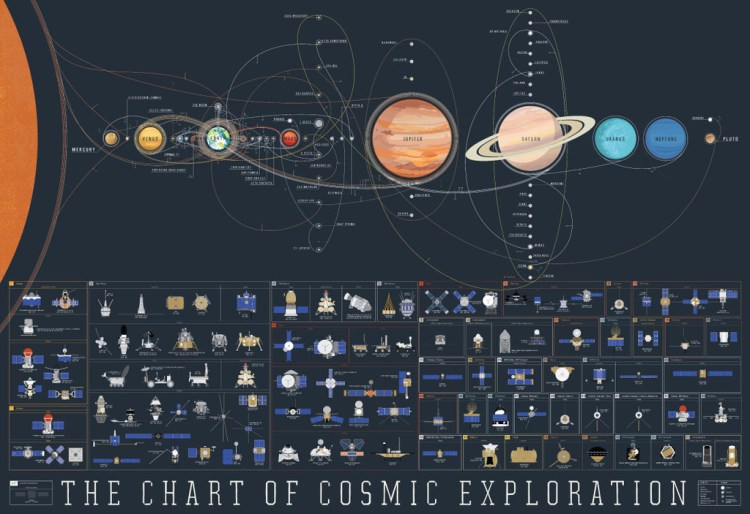
The Chart of Cosmic Exploration
The Chart of Cosmic Exploration shows every space mission to leave Earth’s orbit. The spacecraft and their trajectories through (and out of) the solar system are presented.

Please click HERE to view the chart in detail.
Please click HERE to view the chart in detail.
Monday, March 14, 2016
Jyotish Atrological Projections for the American Presidential Candidates
I was surprised to learn today that International Authors editorial board member and Emanations contributor Sushma Joshi is a practitioner of Jyotish Astrology. In the 13 March post for her blog The Global and the Local, she presents the rundown for three 2016 presidential contenders: Donald Trump, Hillary Clinton, and Bernie Sanders. I think what I like about t his approach to the political process is the way antagonism and conflict are removed from the process, for with astrology it is simply a matter of following the stars.
Here is a photograph of some of her charts. Evidently, she has been addressing the task with great alacrity.

Please click HERE for Sushma's analysis of the candidates and the year ahead in American politics..
Here is a photograph of some of her charts. Evidently, she has been addressing the task with great alacrity.

Please click HERE for Sushma's analysis of the candidates and the year ahead in American politics..
 |
| Sushma Joshi |
Friday, March 11, 2016
The New Technique
My International Authors colleagues Dario Rivarossa and Tiziana "Selkis" Grassi have been collaborating on new images that are worth examining in detail. Here are a few samples from Dario's website:


As I've expressed them to Dario, my impressions:


As I've expressed them to Dario, my impressions:
The technique is very very effective. Distinguished, sophisticated... and you have achieved something that looks genuinely "new." No small feat. Let's use this method to re-work some of the MC illustrations. Layers of activity, layers of form, layers of meaning, a gentle irony, burgeoning humor and insight. The compositional sophistication especially reflects the text beautifully.I've written Dario and Tiziana about the possibility of pursuing more of these images for the forthcoming translation of Tasso's Creation of the World and for Emanations 6.
Thursday, March 10, 2016

Subscribe to:
Posts (Atom)


