Wednesday, December 24, 2014

Expulsion of superstition, nightmares, ghosts and conceptual confusion: from John Milton's "On the Morning of Christ's Nativity" (1629)


XVIII
And then at last our bliss [ 165 ]
Full and perfect is,
But now begins; for from this happy day
Th' old Dragon under ground,
In straiter limits bound,
Not half so far casts his usurped sway, [ 170 ]
And wrath to see his Kingdom fail,
Swindges the scaly Horrour of his foulded tail. 

XIX
The Oracles are dumm,
No voice or hideous humm
Runs through the arched roof in words deceiving. [ 175 ]
Apollo from his shrine
Can no more divine,
With hollow shreik the steep of Delphos leaving.
No nightly trance, or breathed spell,
Inspire's the pale-ey'd Priest from the prophetic cell. [ 180 ]
 
XX
The lonely mountains o're,
And the resounding shore,
A voice of weeping heard, and loud lament;
From haunted spring and dale
Edg'd with poplar pale, [ 185 ]
The parting Genius is with sighing sent,
With flowre-inwov'n tresses torn
The Nimphs in twilight shade of tangled thickets mourn. 

XXI
In consecrated Earth,
And on the holy Hearth, [ 190 ]
The Lars, and Lemures moan with midnight plaint,
In Urns, and Altars round,
A drear, and dying sound
Affrights the Flamins at their service quaint;
And the chill Marble seems to sweat, [ 195 ]
While each peculiar power forgoes his wonted seat. 

XXII
Peor, and Baalim,
Forsake their Temples dim,
With that twise-batter'd god of Palestine,
And mooned Ashtaroth, [ 200 ]
Heav'ns Queen and Mother both,
Now sits not girt with Tapers holy shine,
The Libyc Hammon shrinks his horn,
In vain the Tyrian Maids their wounded Thamuz mourn. 

XXIII
And sullen Moloch fled, [ 205 ]
Hath left in shadows dred.
His burning Idol all of blackest hue,
In vain with Cymbals ring,
They call the grisly king,
In dismall dance about the furnace blue; [ 210 ]
The brutish gods of Nile as fast,
Isis and Orus, and the Dog Anubis hast. 

XXIV
Nor is Osiris seen
In Memphian Grove, or Green,
Trampling the unshowr'd Grasse with lowings loud: [ 215 ]
Nor can he be at rest
Within his sacred chest,
Naught but profoundest Hell can be his shroud:
In vain with Timbrel'd Anthems dark
The sable-stoled Sorcerers bear his worshipt Ark. [ 220 ]
 
XXV
He feels from Juda's land
The dredded Infants hand,
The rayes of Bethlehem blind his dusky eyn;
Nor all the gods beside,
Longer dare abide, [ 225 ]
Nor Typhon huge ending in snaky twine:
Our Babe, to shew his Godhead true,
Can in his swadling bands controul the damned crew. 

XXVI
So when the Sun in bed,
Curtain'd with cloudy red, [ 230 ]
Pillows his chin upon an Orient wave.
The flocking shadows pale
Troop to th' infernall jail,
Each fetter'd Ghost slips to his severall grave,
And the yellow-skirted Fayes [ 235 ]
Fly after the Night-steeds, leaving their Moon-lov'd maze.

Infant Hercules strangling the serpent

Friday, December 19, 2014

Taking Blake too Seriously

As I suggested eleven months ago in a Highbrow memorandum, there is a "risk" in taking William Blake too seriously. Further thoughts along these lines:
  
I find him inspiring, full of anthropological and psychological insights, but I am also weary of where he can lead his admirers. The more I read about him the more I am skeptical. As a  philosopher, he is not as rigorous as his exuberance might suggest. On Locke, for example, his criticisms are over the top and he is dead wrong, and then on top of his haughty and sanctimonious declamations he equivocates--perhaps he realized he was in over his head? A survey of his work and his "claims" demonstrates that he does a lot of equivocating. Along these lines, somewhere he says he is not interested in being precise or accurate, but is rather interested in "consistency"--I take it that he means he is more interested in producing an "impressive composition" than he is in expressing philosophical understanding. I think his claims concerning his superiority to Milton have deceived people. He is no where near Milton as a scholar, a theologian, a historian, a politician, a psychologist, a philologist, a philosopher, an anthropologist, a poet, a professional, a well-connected man of the world, a revolutionary, or what have you. Also, his stuff in The Marriage of Heaven and Hell about Milton being of the devil's party is absurd... But many people take this as a point of departure for claiming Satan is the hero of Paradise Lost. There is a little too much Rousseau in Blake. At a Blake conference someone more knowledgeable than me explained that as the French Revolution went south and plunged into violence, Blake stopped printing Marriage of Heaven and Hell. Blake was withdrawing from the moral relativism and claims for the veracity of "passion" that Marriage espouses. Also, the biographers present ample evidence that Blake wrote some pretty absurd advertisements for his shows in which he made over-the-top claims about himself, his genius, and his prophetic powers. People in the late-18th century art word laughed at this horn blowing, and it seems to me their laughter was justified.

Thursday, December 18, 2014

"A Naval Nobody"

In 1878, young naval officer leveled a number of criticisms against the system of education in the Royal Navy. These criticisms were published in Macmillan's magazine:
I call the whole system of our naval education utterly faulty . . . I say that we, the Navy's youth, are in some professional matters most deplorably ignorant, and the day will come when we, and England, will wake up to the fact with a start. It sounds impossible, inconceivable, that it is only a privileged few who are allowed to make a study of gunnery . . . only a privileged few who are initaited into the mysteries of torpedoes; only a privileged few who are taught . . . surveying and navigation; not even a privileged few who are taught the science of steam, and yet all this is so!
In order to protect the anonymity of the young officer, the authorship of the article was ascribed to "A Naval Nobody".  The author was Lieutenant John Jellicoe, future Commander-in-Chief of the Grand Fleet in the Great War.


Monday, December 15, 2014

Professor Poochigian: "Why Study the Humanities?"

All the humanities do is study the human being as a conscious creature. All the other disciplines study the human as an unconscious creature. There are jobs in studying the human as an unconscious creature. There are no jobs in studying the human as a conscious creature. Why is simple. As conscious, the human has intrinsic value. Having intrinsic value, there are limits to which the human can be employed as a means of satisfying economic interests. As unconscious, the human has instrumental value. Having instrumental value, there are no limits to which the human can be employed as a means of satisfying economic interests.


                                                -- Donald Poochigian

Thursday, December 11, 2014

Geminids Memorandum


Dear Colleagues:

I usually send a memorandum in October, but things have been busy. Here are recent International Authors developments:

1) The Michael Butterworth show is coming to the United States. The books, curios, posters, prints, relics and sundry eclectic materials comprising the show will be on view in the Kent State University library beginning mid-January, 2015. Wednesday March 5, Professor Donald "Mack" Hassler will deliver a lecture on experimental literature, fine arts and Michael's work. A description of the show and a variety of related links can be viewed in a blog post by Jeffery Hodges.

2) The International Authors translation of Torquato Tasso's Il mondo creato (Creation of the World) is proceeding in good order. The translation and editing team members--Dario Rivarossa, Prof. Salwa Khoddam, and myself--are more than half way through the 300+ page poem. This new English-language translation featuring illustrations by the "Magic Trio" (Dario Rivarossa, Tiziana "Selkis” Grassi, and Eva “Nivalis” Nieri) should be out in the first half of 2015. A section from Day 5, "The Poem of the Phoenix" will appear in the verse section of Emanations V. Dario's blog is a good source for the latest news.

3) International Authors has published an anthology of Fantasy Literature entitled Fantasy Worlds. The book is now available through Amazon. The book is on the reading list for a sophomore-level literature course that I am teaching Spring Semester 2015. The course is called, appropriately enough, "Fantasy Worlds". I am happy to say that among many seminal works of fantasy literature, the book contains fiction penned by members of our community, including Elkie Riches, Robert Meadley, and Gareth Jackson. Visit the Amazon sales page(s) here:

Amazon US

Amazon UK

Amazon Euro

The contents can be viewed HERE.

4) In Spring Semester 2014 at Kent State University, Emanations: Thrid Eye was on the reading list for Mack Hassler's Freshman Forum in the Kent Honors Program. Story and pictures HERE.

5) A number of outstanding submissions have been received for Emanations V. Submissions are still being accepted; the Call can be viewed HERE.

6) On behalf of International Authors, I am donating a complete set of our titles to the Belmont College library. This effort is still evolving, but it looks like a newspaper article will emerge. More on this development to come.

7) International Authors is supporting the publication of Steve Aylett's forthcoming book The Heart of the Original. Many thanks to Elkie Riches and C. E. (Chris) Matthews for their generous assistance. A description of Steve's project can be viewed HERE.

8) I want to underscore my thanks and appreciation. As well, I wish to apologize if I have not gotten back to you in a timely manner. Along these same lines , I wish to double-underscore that nothwithstanding the terrific editorial support I receive (and let me again thank Holly Baumgartner, Elkie Riches, Jeffery Hodges, Kai Robb, Dario Rivarossa, Mike Chivers, Michael Butterworth, Gareth Jackson, and Mack Hassler for all their tremendous efforts) many facets of Emanations production remain a "one-man operation." I try to accommodate everyone as best I can, but sometimes the exigencies that characterize a seven-day-work-week require me to demur, hide, remain passive, walk in the woods, or what have you. I want this to be a good experience for all concerned. If you wish to contact me with your concerns, please do so. The facebook page devoted to International Authors is an active and useful forum, and it is always available to test ideas, work through ideas, and so on. The IA web site contains links to the various members of the editorial board, and so affords other avenues for communication. Along these lines, please use the contacts represented by our consortium to develop projects for publication. As in all things: communicate, get to know each other, stay in touch, keep the channels open.

Best wishes for the holidays and the solstice,

Carter Kaplan


Friday, December 5, 2014

International Authors in Florence

I just received these photos of IA editorial board members Dario Rivarossa and Mack Hassler meeting in Firenze--with entourage.

Mack, Paola, and Dario before Ponte Vecchio.


Sue, Dario and Paola before the Duomo. Dario can lecture on architecture and sign books at the same time.


Now time to eat...

Saturday, November 29, 2014

Fantasy Worlds is now available

Fantasy Words is International Authors' anthology of fantastic fiction, poetry and essays for very intelligent students.  Please click HERE to view the Amazon sales page.


           Contents

INUIT LEGEND
  Sedna, Mistress of the Underworld
JAPANESE LEGEND
  A Story of Oki Islands
HOMER
  from The Iliad Book 1.1-52
  from The Iliad Book 18.202-214
  from The Iliad Book 18.462-616
  from The Odyssey Book 11
JOHN MILTON
  from Paradise Lost Book 1.1-330
  from Paradise Lost Book 2.614-1055
NATHANIEL HAWTHORNE
  The Hall of Fantasy
  Young Goodman Brown
WILLIAM BLAKE
  from The Marriage of Heaven and Hell
  The Tyger
WILLIAM WORDSWORTH
  The world is too much with us
  I wandered lonely as a cloud
PERCY BYSSHE SHELLEY
  Ozymandias
JOHN KEATS
  On First looking into Chapman’s Homer
  Le Belles Dame sans Merci: A Ballad
ALFRED LORD TENNYSON
  The Lady of Shalott
  The Kraken
W. B. YEATS
  Sailing to Byzantium
  Byzantium
  The Second Coming
GEORGE ORWELL
  W. B. Yeats
  The Scientists Take Over
CARTER KAPLAN, ET AL.
  Surrealmageddon
CHARLOTTE PERKINS GILMAN
  The Yellow Wallpaper
H. G. WELLS
  The Country of the Blind
  The Crystal Egg
H. P. LOVECRAFT
  The Call of Cthulhu
  from Supernatural Horror in Literature
CLARK ASHTON SMITH
  The City of the Singing Flame
ELKIE RICHES
  Beware the Subtle World
ROBERT MEADLEY
  Meeting Dr. Malthusian
GARETH JACKSON
  Everything Changes

Thursday, November 27, 2014

Happy Thanksgiving

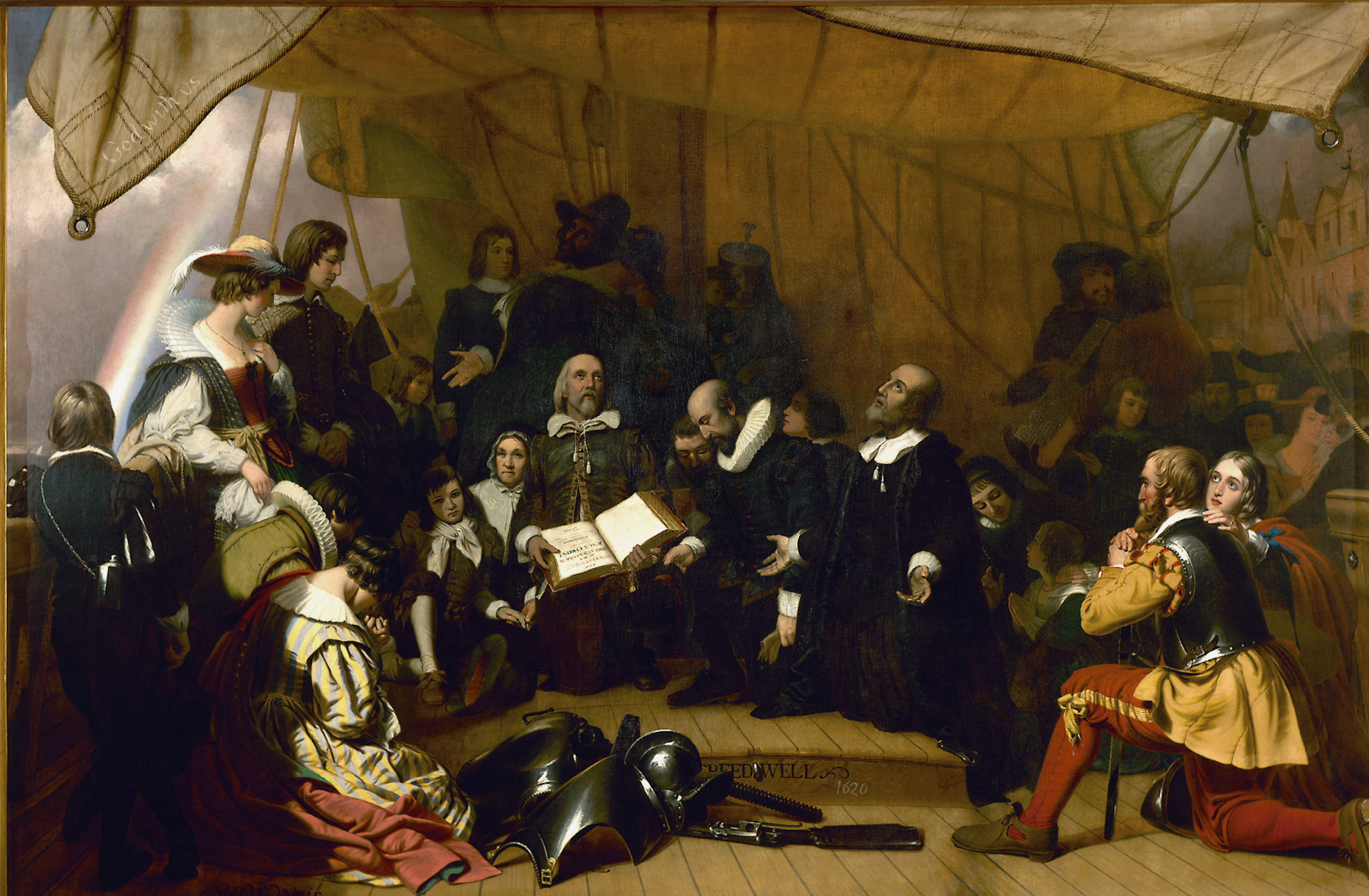
Embarkation of the Pilgrims at Delft Haven, Holland, July 22, 1620 by Robert Weir


Weir's painting depicts the Pilgrims aboard Speedwell before their departure for the New World from Delft Haven, Holland, on July 22, 1620:  William Brewster, holding the Bible, and pastor John Robinson leading Governor Carver, William Bradford, Miles Standish, and their families.

Mayflower and Speedwell set sail for America on August 15, but Speedwell developed a leak and  both ships turned back for England, landing first at Dartmouth and then at Plymouth. Mayflower set sail for America alone on September 16.  Sixty-six days later the Pilgrims arrive in Massachusetts.  William Bradford writes:
Being thus arived in a good harbor and brought safe to land, they fell upon their knees & blessed ye God of heaven, who had brought them over ye vast & furious ocean, and delivered them from all ye periles & miseries therof, againe to set their feete on ye firme and stable earth, their proper elemente. And no marvell if they were thus joyefull, seeing wise Seneca was so affected with sailing a few miles on ye coast of his owne Italy; as he affirmed, that he had rather remaine twentie years on his way by land, then pass by sea to any place in a short time; so tedious & dreadfull was ye same unto him.

But hear I cannot but stay and make a pause, and stand half amased at this poore peoples presente condition; and so I thinke will the reader too, when he well considered ye same. Being thus passed ye vast ocean, and a sea of troubles before in their preparation (as may be remembred by yt which wente before), they had now no friends to wellcome them, nor inns to entertaine or refresh their weatherbeaten bodys, no houses or much less townes to repaire too, to seeke for succoure...

Let it also be considred what weake hopes of supply & succoure they left behinde them, yt might bear up their minds in this sade condition and trialls they were under; and they could not but be very smale. It is true, indeed, ye affections & love of their brethren at Leyden was cordiall & entire towards them, but they had litle power to help them, or them selves; and how ye case stode betweene them & ye marchants at their coming away, hath already been declared. What could not sustaine them but ye spirite of God & his grace? May not & ought not the children of these fathers rightly say: Our faithers were Englishmen which came over this great ocean, and were ready to perish in this willdernes; but they cried unto ye Lord, and he heard their voyce, and looked on their adversitie…
Verily, as we sit down on this day to the feast of remembrance ponder with all gentle humility those miseries and doubts such as our Fathers overcame,--as well for your spirit's sake, appreciate gladly and mildly that wonderful juicy turkey, those savory potatoes, hardy stuffings, toasted green vegetables, cranberry sauce, steaming rolls and muffins, sparkling beverages, which nourish and vivify our bodies with strength and energy, and pumpkin pie withal!

Wednesday, November 26, 2014

La Magia

Tomorrow while many of us are dining upon turkey, Dario Rivarossa will be lecturing on magic and witchcraft for the Dante Alighieri Society.


Please click HERE for Dario's announcement.

And click the following title for Dario's book on the subject:  Dante Was a Fantasy Writer.  Here (from the Amazon page) is Professor Hodges' brief review of that book:
Mr. Rivarossa, a writer of surprising, imaginative insights, is willing to entertain the possibility that many of the features found in current-day fantasy literature are also present in Dante's Divine Comedy. He thus finds not only fairies, elves, dragons, witches, and magical enchantments, but even such Gothic features as vampires and werewolves! Accompanying these speculative re-readings of Dante are Mr. Rivarossa's own illustrations, his imaginative reconstructions of what Dante describes. Always with good humor, Mr. Rivarossa presents his speculations not as indisputable fact -- such would not be worthy of fantasy! -- but as a means of getting us to reconsider what Dante was saying. As a work of imagination that provokes thought, and does so in a lively style, the book receives five stars from me.

Tuesday, November 25, 2014

CBS Radio Workshop: Brave New World (introduced by Aldous Huxley)


Please click HERE to listen to Brave New World and other radio plays.

Saturday, November 22, 2014

Butterworth coming to America?

Highbrow readers are familiar with the Butterworth/Savoy Exhibition at the International Anthony Burgess Foundation, Manchester. Back channel conversation hints that the show will come to North America in 2015.  Watch this space for further developments.

Please click HERE for a description and additional links related to the show.

Please click HERE for Gareth Jackson's photos.

Philip Murray-Lawson's interview with Michael Butterworth:  Part I   Part II

Friday, November 21, 2014

The Nostalgia of the Infinite (2100 BC)

Remains of ziggurat from Uruk honoring Inanna


Je suis le ténébreux, le veuf, l’inconsolé,
Le Prince d’Aquitaine á sa tour abolie… 

                              -- Gérard de Nerval

Wednesday, November 19, 2014

Thursday, November 13, 2014

Friday, November 7, 2014

H. P. Lovecraft on Clark Ashton Smith

In his essay on Supernatural Horror in Literature,  H. P. Lovecraft offers the following gloss on Clark Ashton Smith:
Of younger Americans, none strikes the note of cosmic horror so well as the Californian poet, artist and fictionist Clark Ashton Smith, whose bizarre writings, drawings, paintings and stories are the delight of a sensitive few. Mr. Smith has for his background a universe of remote and  paralyzing fright—jungles of poisonous and iridescent blossoms on the moons of Saturn, evil and grotesque temples in Atlantis, Lemuria, and forgotten elder worlds, and dank morasses of spotted death-fungi in spectral countries beyond earth’s rim. His longest and most ambitious poem, The Hashish-Eater, is in pentameter blank verse; and opens up chaotic and incredible vistas of kaleidoscopic nightmare in the spaces between the stars. In sheer daemonic strangeness and fertility of conception, Mr. Smith is perhaps unexcelled by any other writer dead or living. Who else has seen such gorgeous, luxuriant, and feverishly distorted visions of infinite spheres and multiple dimensions and lived to tell the tale? His short stories deal powerfully with other galaxies, worlds, and dimensions, as well as with strange regions and aeons on the earth. He tells of primal Hyperborea and its black amorphous god Tsathoggua; of the lost continent Zothique, and of the fabulous, vampire-curst land of Averoigne in mediaeval France. Some of Mr. Smith’s best work can be found in the brochure entitled The Double Shadow and Other Fantasies (1933).
In his Introduction to the Dover edition of Lovecraft's essay, E. F. Bleiler expresses his disagreement:
In terms of critical position, Lovecraft, I believe, overrated both Lord Dunsany and C. A. Smith. The case of Smith, the only contemporary American author whom Lovecraft regarded with awe, is puzzling.
In answer to Bleiler, and setting aside Dunsany for the nonce (we will consider him in some future Highbrow installment), I should not consider it impossible to assume that Lovecraft's praise is an expression of admiration for a friend. Indeed, however, the nature of this friendship is literary. Considering the "vibrating" enthusiasm of his praise--the curious pharmacological language underscoring toxicants, paralysis, and the "spaces between the stars"--I can only conclude that Lovecraft is not simply considering the material of Smith's work, but is moreover praising Smith as a person who has thoroughly and genuinely fallen under his (Smith's) own spell. That is, the criterion that so impresses Lovecraft is the legitimacy of Smith as a flesh and blood exponent of the self-same mystique Smith is aspiring to achieve through his work. Smith's independence and reclusive nature are well known. Indeed--and I think this is Lovecraft's detail--Smith is not only the poet of those spaces between the stars, he himself is the embodiment of those grand dimensions. Considering the nature of their--Lovecraft and Smith's--craft, could there be a higher departure point for praise?

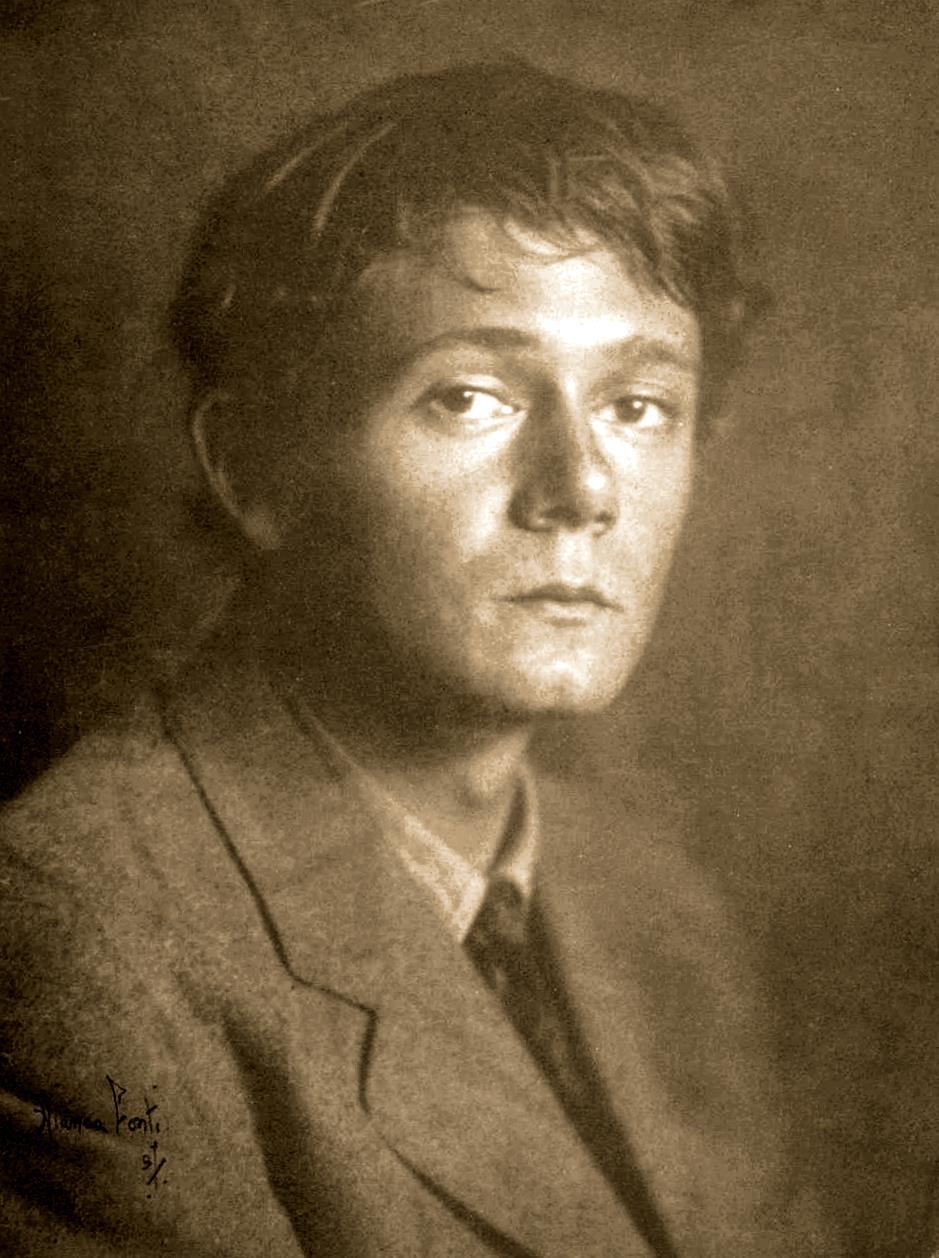
Clark Ashton Smith in 1912