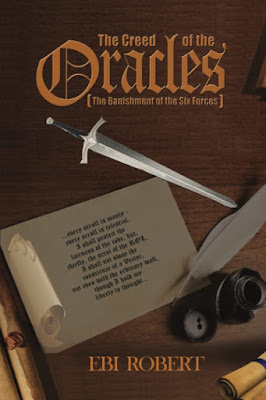
Ebi Robert is inviting you to a scheduled Zoom meeting.
Topic: Public Presentation of The Creed Of The Oracles
Meeting ID: 743 8585 0181
Passcode: UVd4kJ
Here are some lines from a conversation
between Michael Butterworth and Ebi Robert about Mr. Robert’s new novel, The
Creed of the Oracles.
Michael Butterworth writes:
I finished reading your book just after your email arrived, and I'm impressed. You have created a convincing world/mythology. The names of things and people -- always difficult to get right -- are really very believable, like in a Moorcock, Leiber or Edgar Rice Burroughs novel. The narrative carried me along: I wanted to know what happened next, at least. It will be interesting to see how you take the story in your promised sequel. There were many small details, also, which also appealed. I will mention just one: the horse Bester. A reference to Alfred Bester, the writer? Anyway, it is a good name for a horse! A pity Bester is an old horse, as he and Erecious, the latter brought out of retirement, should definitely ride again. I'm anticipating your two dwarf characters will be the sidekicks. They should be.
A surprise was the strong swords and sorcery element, which dawned only gradually. The Bones Banez illustration was a big clue, though at first I didn't see the connection.
Is heroic fantasy a popular genre in Nigeria, or SF/fantasy generally?
Ebi Robert responds:
No. It's not a popular genre in Nigeria. Only a few writers in Nigeria are looking towards that direction.
Generally, fantasy as a genre is not completely new to Nigerian writers. We've had some writers do some work in speculative fiction. However, I can say that we can be easily counted or numbered. Heroic fantasy or high fantasy is not popular in Nigeria. To a very large extent, some writers have seen fantasy as a western brand. Some others believe that we've got so many stories over here that are still untapped, so why write about something that is not there in the first place?
Many Nigerian writers busy themselves with talking and writing about contemporary issues that they feel affect them. Corruption, bad governance, politics, democracy, slavery, colonialism, and many more are some of the issues before us. Recently, issues like climate change, domestic violence, and oil theft are beginning to take centre stage.
I believe writers hardly consider fantasising because they have so much to write about and talking about them will expose those themes or subject matters to the outside world. Put another way, there are so many vices facing our society that must be spoken about. So seeing a writer engage in world-building in this part of the world is rare, very rare, I must say.
But I'm bold to say that it's somewhat of an emerging genre. Heroic or high fantasy is not just any genre that anyone can write overnight. It takes a whole lot of creativity and hard work to achieve just one. In addition to the above, this aspect is a contributory factor.
But there have been some attempts in other areas of speculative fiction, such as science fiction, and maybe, relatively speaking, what I can classify as low fantasy, if there is any sub-genre like that. What I mean is that such imaginative work is not really an out-of-this-world thing. A few such works are mostly centred on Planet Earth, with settings in known places but with characters having some supernatural abilities.
A renowned Nigerian professor in the field of literature once described my works as experimental, and I think I agree with his opinion. I have always looked forward to doing something rarely done, something rarely considered—writing something original. It is this desire to tell my story in what I considered to be an unconventional way that led to me adopting this approach. The Creed of the Oracles is not just a fantasy; it doubles as an allegory.
I should add that it is the experimental aspect that originally attracted me to the novel. The language and the culture of legal scholarship that Mr. Robert has invented represents a fusion of culture, law (Mr. Robert is an attorney in Nigeria), and the procedures of a strange Medieval guild—all cleverly imagined.
Please click HERE to view the Amazon sales page for The Creed of the Oracles.

Early next year. More on this later.
A picture just came across my desk of International Authors editorial board members Vitasta Raina and Horace Jeffery Hodges. Ms. Raina is in Seoul for meetings, and she took the opportunity to visit Professor Hodges and his family.
Vitasta Raina is the author of the novella Writer's Block, and Horace Jeffery Hodges is the author of a collection of poems, Radiant Snow--both published by International Authors. Please note that Ms. Raina designed the cover of Prof. Hodges' collection.
Click the titles to view the Amazon sales pages.
Please click HERE (or click the cover image) to visit the Amazon sales page.
Ebi Robert is a Barrister and Solicitor of the Supreme Court of Nigeria
in the City of Yenagoa, in Bayelsa State. He practices law at F.B.A.
Nabena & Co. and also serves as a Probono Lecturer at the Faculty of
Law, Niger Delta University, where he assists in teaching Cybercrime
Law and International Law. He has published extensively in the field of
Law. His poems have been published around the world in anthologies,
journals and ezines. He has published two plays: An Empty Kingdom and Zige. The Creed of the Oracles is his first novel. Website: www.ebirobert.com
Note: The book features an illustration by painter Bienvenido Bones Banez, Jr. Please click HERE for more information about Mr. Banez.


 |
| Reliance (l) & Shamrock III (r) begin the race for the America's Cup, 1903 |
Reliance, the American yacht, would win. Please click HERE for a high resolution image.
My good friend and International Authors colleague, Horace Jeffery Hodges recently launched a global appeal to fill the libraries of the world with copies of Emanations, International Authors' somewhat-annual anthology of poetry, fiction, art and essays.
Please click HERE to learn further details of Professor Hodges' initiative.
 |
| Professor Hodges in the field. |
Emanations vols. I-IX are now part of the Special Collections archive at the Kent State University Library.
 |
| Mack Hassler |
 |
| Cara Gilgenbach |
"I should like to say two things, one intellectual and one moral: The intellectual thing, I should want to say to them, is this: When you are studying any matter, or considering any philosophy, ask yourself only "what are the facts, and what is the truth that the facts bear out?" Never let yourself be diverted, either by what you wish to believe, or by what you think could have beneficial social effects, if it were believed. But look only and solely at: "What are the facts?" That is the intellectual thing that I should wish to say. The moral thing I should wish to say to them is very simple. I should say: Love is wise, hatred is foolish. In this world, which is getting more and more closely interconnected, we have to learn to tolerate each other. We have to learn to put up with the fact, that some people say things that we don't like. We can only live together in that way. And if we are to live together and not to die together, we must learn a kind of charity and a kind of tolerance, which is absolutely vital to the continuation of human life on this planet."
Earlier this month, I posted a statement from Richard Kostelanetz concerning his publishing activities with Archae Editions and Avant-Garde Classics. Please click HERE for that statement.
I was very fortunate to be involved with the Avant Garde Classics edition of Moby-Dick, which features introductory material from Mr. Kostelanetz, John Rocco, and myself. Also, the edition includes D.H. Lawrence's influential 1922 essay on the novel.
The Amazon description reads as follows:
Since reprints and revisions of Herman Melville’s Moby-Dick (1951) are readily available, this is the original American printing, whose proofs its author presumably approved. That accounts for why it concludes with the publisher’s full-page advertisements, at once quaint and informative, for Melville’s earlier books. Adding to its status as a classic about a classic, this edition (7” x 10”, large typeface) reprints in its entirety D. H. Lawrence’s extended appreciation (1922) and the shorter entries contributed by John Rocco and Carter Kaplan to Richard Kostelanetz’s Dictionary of the Avant-Gardes (third edition, 2018).
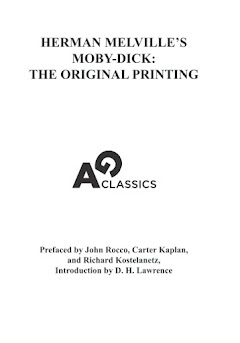
I should underscore that the publisher's many advertisements appearing at the end of the book are a surprising and intriguing feature. Please click the cover image (or click HERE) to visit the Amazon sales page.
A copy of Emanations: When a Planet was a Planet has reached poet Ebi Robert in Nigeria. Mr. Robert is a long-time contributor to Emanations, and his upcoming novel The Creed of the Oracles will be published by International Authors.

Octo-Emanations and Emanations: When a Planet was a Planet are now available at Space Cowboy Books, Joshua Tree, California.

Space Cowboy books will publish a collection of Michael Butterworth's poems, The Complete Poems 1965-2020, due out late 2022.
In the following statement, Richard Kostelanetz describes his Archae Editions and Avant-Garde Classics imprints:
In
memory of Dick Higgins (1938-1998),
who
understood what alternative publishers had to do
Freedom
of the press is limited to those who own one.
–A. J. Liebling
I founded Archae Editions a decade ago
to make available new books of mine that wouldn’t otherwise be published—of a quality
that persuaded me that they would survive me, even with only one enthusiastic reader.
I favored Amazon/KDP because its prices could not be beat and then because the company
was more likely to survive not only me but its competitors in the new business of
on-demand publishing.
Since my purpose was circulation, I
usually priced Archae Editions as cheaply as Amazon allowed and then generally purchased
three copies —two for my own shelves, and one for my monthly Last Sunday bookstore.
The exceptions to my low retail costs were Posthumous Books, as I call them, that
charged as high as Amazon allowed. I wanted them to exist in a definitive form,
though their price would discourage wider circulation until a later date. Since
I’ve become crippled without regular assistance, I can rely on Amazon to deliver
my books to their customers. With on-demand printing, the costs per copy are the
same for one as for many. Thanks to this new “on-demand” way of printing books,
nothing need be stored.
Around 2017 I opened my initially personal
imprint to “classic” manuscripts that I judged would likewise survive and so published
volumes by D. E. Steward, Enzo Minarelli, David Morice, Alberto Vitacchio, Alex
Caldiero, and Charles Doria. Recently I decided that their titles belong, beside
certain other books of mine, under the imprint of AVANT-GARDE CLASSICS and so commissioned
another logo (thanks to Igor Satanovsky) and established a second name with Amazon.
Because Amazon prigs have rejected some Archae books (and twice even cancelled all
of my Archae books from its listings, only to reverse), I’ve printed several Classics
with Barnes&Noble’s on-demand service, which charges roughly 30% more. After
giving these authors some gratis copies, I advise them to order additional copies
for themselves through me, who gets a cheaper publisher’s price. Please don’t expect
enough business or staff to pay royalties soon.
Once I established Avant-Garde Classics,
I decided that certain Archae books by me really belonged to this new imprint: my
own versions of F. M. Marinetti, Guillaume Apollinaire, and Gustave Flaubert’s Dictionary;
and my selections of texts by others, such as Kosti’s (Richard) Foreman, as well
as my illustrating Edgar Allan Poe’s Maelstrom with verbal/visual images of my own
and, of course, certain titles wholly my own.
The first author initially published
under this new imprint was, of course, Gertrude Stein, who remains a modernist idol
to me. In addition to reprinting her monumental The Making of Americans, not only
at a lower retail price than any competitor but with my long introduction to the
more radical Stein texts. From books of hers already in the public domain, I extracted
Early Geographies and Early Plays, both with the addition of my long introduction.
From later Stein collections I similarly extracted sections that I could cost well
below the price of the source book, even if it were previously owned. Again my motive
was making avant-garde classics available.
With Ezra Pound, another modernist icon
with many books in print, I had to find what was not otherwise available. First
I reprinted within a single volume his long appreciations of the visual artist Gaudier-Brzeska
and the composer George Anthiel. Secondly, I found that Pound’s early collection
of criticism, Instigations (1920), had three kinds of essays scrambled together
and so extracted three separate volumes: One about French writers, a second about
Chinese and Greek, and a third mostly about those writing in English. I expect to
do, within a single volume, several short books of poetry that he published before
turning 30.
If only because Guillaume Apollinaire
and was born Kostrowitski and known to his buddies as Kostro, I’d already translated
certain essays of his, as well as his longer poem Zone. For AGC, I’ve reworked Matthew
Josephson’s pioneering century-old translation of Le poète assassiné as The Poet
Offed. With an intern who’s a graduae student, I’m working on an edition entirely
in French of his Alcools entwined with his Calligrammes; a thicker book with four
of his lesser-known titles, again only in French; and a translation into English
of La femme assise, which, as far as I can tell, is a Kostro novel ethat has not
been translated before.
Since the anarchist Emma Goldman died
the exact day I was born (14 May 1940) and her politics remain sympathetic, I composed
one book from three longer texts, including My Disillusionment with Russia, and
am planning another of her shorter essays. Out of respect for Ambrose Bierce, who
was the first writer I treasured on my own (because his books weren’t taught to
me), I’ve published a book of his Newspaper Poems and another of choice essays and
satires. Years ago, I appropriated Nathanael West’s most radical text into Kosti’s
Pep Dream (2013) and so now reprint those pages as an AGC.
I’ve also enhanced the typography of
certain favorite high modernist texts, such as T. S. Eliot’s early poems and Wallace
Stevens’ “Sunday Morning,” which appears before my redesign of “Casey at the Bat,”
to establish through audacious publishing an unfamiliar critical point about two
favorite poems. AGC reprints intact the pages of H. L. Mencken’s Schrimpflexicon (1928), which is
avant-garde for containing few words written by him, while this screamingly funny
book is still uniquely Mencken. At least two other AGCs have a source I cannot announce,
because in certain places they might still be under copyright.
By putting together my modest redesigns
of other books not normally found together I was able to make a critical point.
The theme of combining Henry David Thoreau’s Civil Disobedience and Mark’s Twain’s
Awful German Language is that the greatest American essays can be more solemn and
comic. As an appendix to the only complete translation of Ivan Turgenev’s Poems
in Prose, I reprint an early translation of the Charles Baudelaire prose poems that
inspired Turgenev. The theme of Four Literary Translators is that Kenneth Burke,
Ezra Pound, James Gibbons Huneker, and Virginia Woolf all published their personal
translations (respectively of Thomas Mann, Rene de Gourmont, Charles Baudelaire,
and Fyodor Dostoevsky) that were superseded or discarded. Sprinkled between the
pages of my print of John Dos Passos’ Manhattan Transfer (1925) are pages from Frans
Masereel’s Die Stadt (also 1925), visual fiction composed from woodcut images, followed
by an appendix of poems from the 1920s likewise portraying urban life. a Since H.
L. Mencken has sometimes been dubbed anti-Semitic, I reprinted within a single set
of covers two early book-length appreciations by the Jewish critics Isaac Goldberg
and Benjamin de Casseres.
Respecting my interest in avant-garde
cultural magazines, I’ve reprinted in a single large volume the complete runs of
two magazines edited by Wyndham Lewis —Blast and Tyro —and in another thick book
the complete run of Alfred Jay Nock’s The Freeman, as addition to a slimmer volume
with the three American magazines edited by Marcel Duchamp, a fourth with six disparate
issues of Emma Goldman’s Mother Earth, and a fifth with the complete De Stijl still
in Dutch. (Why translate a magazine whose pages must be seen before they are read.)
A much shorter volume incudes the complete contents of the pronto-minimalist Matchbook
edited by David Morice. In production are books with the complete run of The Broom
and several years of Margaret Anderson’s The Little Review.
Because most of these titles are minimally
popular, the AGCs have no visible competition. In those cases where they might be
available from antiquariats or other reprinters, I’ve added materials unavailable
anywhere else, either with my own prefaces or some supplementary material. To the
facsimile of the first American printing of Herman Melville’s Moby-Dick, I’ve added
not only my slight preface but longer appreciations by D. H. Lawrence and two professors
who’d contributed Melville entries to the third edition of my A Dictionary of the
Avant-Gardes (2018). Once a notoriously titled 1926 novel by Carl Van Vechten entered
the public domain, I slightly rewrote it to appear as Harlem Heaven, which was the
actual subject of the historic book. I had to reprint William Blake: His Philosophy
and Symbols by my great teacher S. Foster Damon, still available second-hand at
a reasonable price, but now with appendices by Damon himself on how he wrote his
masterpiece and then the scholar Morris Eaves on Damon’s achievement.
Another move has been combining one
writer’s complimentary texts within a single volume; so that along with poems by
the modern American writer Benjamin de Casseres I reprint a prose book by him. While
only the fiction of another American writer James Weldon Johnson figured in my M.A.
thesis of 1966 (Columbia), I wanted to recognize his other achievements as a poet,
reporter, lyricist, anthology, and musicologist and so collected within a single
book selections from his work in all these domains. One move that someone should
have done before (but didn’t, oddly) was reprinting Yvor Winters’ extraordinary
1928 appreciation of Native American poetry, now along with the two contemporaneous
anthologies that he was writing about.
With certain favorite neglected writers, I reprint two or more earlier books
within a single set of covers; so just as Elbert Hubbard’s Notebooks complement
his Sketchbooks, I’ve put together in single volumes all three books by Minna Antrim,
an American aphorist popular in the early 20th century; five books by the writer/architect
Claude Bragdon; and several early books of both poetry and prose by the poet/physician
William Carlos Williams.
Another theme of my publishing has been
recovering ancient texts that retain avant-garde quality. One example was Meditations
on a Divine Name by the Jewish mystic Abraham Abulafia (1240-1291) as prefaced by
Enzo Minarelli. In production is a new edition of On the Composition of Images,
Signs & Ideas by Giordano Bruno (1548-1600) as translated by Charles Doria and
edited by Dick Higgins. (As I write, Amazon is offering only one copy of the 1991
edition for the whopping sum of $449.75.) Michael Peters is presently compiling
texts by the American novelist Charles Brockden Brown (1771-1810).
AGC’s co-star has been Charles Doria,
my colleague for decades, with examples of his brilliant literary book-art, his
translations, his visual/verbal interpretations of texts by others, and much else
unusual, all of which, in my judgment, has the quality worthy of an avant-garde
classic.
I’m not done yet with books meant to
survive. I’d like to reprint some titles that are currently scarce, such as the
1926 “private edition” of T. E. Lawrence’s Seven Pillars of Wisdom, A. L. Gillespie’s
Syntactic Structures, Bern Porter’s masterpieces, Frank Kuenstler’s Lens, Loïe Fuller’s
memoir of her experience as an American artist in Paris, books by and about the
19th-century American actress/writer Adah Isaacs Menken, Alfred A. Knopf’s anthology
of his first years in book publishing, or the self-published retrospectives of the
French poet Henri-Martin Barzun who lived for half a century in America. As I own
a complete run of the legendary transition literary magazine, I reprinted its 27th
number intact, if to test if I could safely do more. I expect to reprint the complete
run of Gellet Burgess’s The Lark, which I also happen to own. And rather than printing
annual catalogs, AGC will post on Amazon a continually expanding book of just title
pages alphabetically organized, Avant-Garde Classics, priced as cheaply as possible,
natch.
Because I’ve other work to do, I’m trying
to keep this operation simple. That accounts for why I’ve not placed ads, written
press releases, or submitted review copies. In my experience, none of these publishing
mechanisms have worked at selling my own books (or my getting recognitions in history
books) as well as personal recommendations from one reader to another.
–Richard Kostelanetz, FarEast BushWick, 1 March 2022
Please click HERE to find Archae Editions and Avant-Garde Classics.