
Thursday, July 5, 2012


Thursday, June 28, 2012
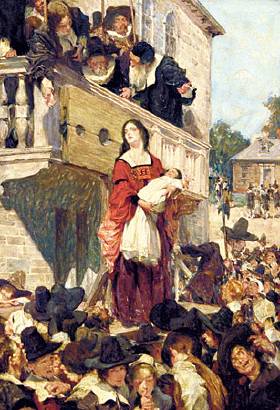
The International Authors edition of The Scarlet Letter

Nathaniel
Hawthorne (1804-1864) was
an American short story writer and novelist. Known for sophisticated allegorical
and moralistic tales often set in New England, he was the first American author
to produce a uniquely American epic, The
Scarlet Letter, a work that sets the pattern for the Great American Novel, a
thematic form built upon a post-Calvinist worldview that intermingles an ironic
appreciation for human individualism with a determined commitment to political liberty
and intellectual freedom. Herman Melville’s Moby-Dick
and Mark Twain’s The Adventures of
Huckleberry Finn are heirs to Hawthorne’s revelation.
A classic of literary art and intellectual history, The Scarlet Letter
represents a definitive formulation of the classic liberal ideas that
mark the emergence of the modern world. Like the Declaration of
Independence, The Scarlet Letter
stands on the shoulders of well-evolved political and theological
discussions advancing a range of related notions concerning human
nature, individualism, community, open public disclosure, the “real”
authority of law, separation of government institutions and powers, and
the separation of church and state. Featuring a penetrating afterword by
Carter Kaplan, the International Authors edition of The Scarlet Letter is intended for students and scholars seeking to cultivate a deep appreciation for Hawthorne's genius and art.
Click here (or the cover image) to purchase.Saturday, June 23, 2012
Friday, June 15, 2012
Sunday, May 13, 2012
John Locke's Place in Intellectual History
It is the doctrine of toleration
rather than the scientific epistemology of An
Essay on Human Understanding (1693) that is Locke’s signal contribution to
modern philosophy. Ill-informed and culpable voices in intellectual history have erroneously
placed the Essay at the center of
Locke’s thought. Locke—as well as the
actual measurable influence of his ideas on the way we live in the modern
world—does not place this importance on the
Essay, and from the time of Bishop Berkeley to the present day the Essay has been falsely elevated within
Locke’s oeuvre so as to deflect
attention from Locke’s central contributions. Beginning with Bishop Berkeley,
this practice has in some instances been the opening move in clearing the way
philosophically for constructing various illiberal and repressive political
systems that are supposedly based on more accurate “scientific” foundations
than Locke’s skeptical epistemology. Locke has thus been identified as part of
a larger Enlightenment straw man that is the target of those seeking to advance
the authoritarian agenda of Continental philosophy, which as a program, in
anthropological terms, seems to be the logical systemic outcome of an
increasingly corporate, nihilistic and authoritarian Academy. To put the story
straight, An Essay on Human Understanding
is Locke’s commonplace book, a record of tentative speculations. It is not his
philosophy but rather an exercise in the method
of his philosophy, and in this method conviviality, measured skepticism and unhurried
consensus are as important as the progression of his epistemological propositions.
The Essay serves Locke’s higher
project to bring people together. Locke’s thinking on the subjects of religious
toleration and social and political diversification represent the actual center
of his philosophy. This philosophy was published in his Letter on Toleration (1689) and Two
Treatises of Government (1690). The doctrines of tolerance and the
diversification of powers that are elaborated in these documents are clearly
based upon the same fundamentals of religious toleration and republican democracy
negotiated among the Independents and the sectaries during the English Civil
War. John Locke’s father, it should be remembered, was an officer under
Cromwell. As well, the patronage of the Earl of Shaftesbury is additionally
illustrative of the connection between the Good Old Cause and Locke’s theology
and politics.

.png)
Monday, April 23, 2012
Professor Hodges on Robert Wickenheiser and the Williamsburg Circle
International Authors editor Jeffery Hodges has written some interesting blog entires on matters of interest to the highbrow community: first, Dr. Wickenheiser's recent talk on collecting Milton; second, a related piece in which Jeffery explores his vision for the Williamsburg Circle of International Arts and Letters.
Wednesday, April 11, 2012
April 14-15: Paradise Lost Collectors' Weekend and Williamsburg Circle of International Arts & Letters Dinner
135 Broadway, Brooklyn, NY 11211
(718) 486-6012
Paradise Lost Collectors Weekend:
Antiquarian Books and Art Exhibit
April 14th Schedule:
2 PM: Dr. Robert J. Wickenheiser, major collector of Milton's Paradise Lost books, art and related materials will talk on an exhibit of items from his collections.
6 PM: The Williamsburg Circle of International Arts and Letters Annual Dinner and Open Meeting in the Grand Reception Hall, gorgeously replete with old master paintings and historic displays.

April 14 & 15, 2012
Featuring the Annual Williamsburg Circle of International
Arts & Letters Dinner
Arts & Letters Dinner
1-2 PM: Paradise Lost Art Early Buying - Many artists proofs, drawings, ephemera of Terrance Lindall's work on Paradise Lost spanning 30 years, plus contemporary Paradise Lost art by other fine artists.
2 PM: Dr. Robert J. Wickenheiser, major collector of Milton's Paradise Lost books, art and related materials will talk on an exhibit of items from his collections.
6 PM: The Williamsburg Circle of International Arts and Letters Annual Dinner and Open Meeting in the Grand Reception Hall, gorgeously replete with old master paintings and historic displays.
Sunday, March 18, 2012

Sunday, March 11, 2012
George Orwell on That Hideous Strength
I
was looking around the internet and found George Orwell's brief but fascinating
review of That Hideous Strength, a dystopian novel by C.S. Lewis. Orwell
is convinced by the basic premise of the book:
A company of mad scientists – or, perhaps, they are not mad, but have merely destroyed in themselves all human feeling, all notion of good and evil – are plotting to conquer Britain, then the whole planet, and then other planets, until they have brought the universe under their control.
All superfluous life is to be wiped out, all natural forces tamed, the common people are to be used as slaves and vivisection subjects by the ruling caste of scientists, who even see their way to conferring immortal life upon themselves.
According to Orwell, “There is nothing outrageously
improbable in such a conspiracy,” adding that he
“could
recommend this book unreservedly” but for the fact the supernatural element in
the story “keeps breaking in, and it does so in rather confusing, undisciplined
ways.” Orwell concludes:
[Lewis] is entitled to his beliefs, but they weaken his story, not only because they offend the average reader’s sense of probability but because in effect they decide the issue in advance. When one is told that God and the Devil are in conflict one always knows which side is going to win. The whole drama of the struggle against evil lies in the fact that one does not have supernatural aid.These are terrific lines. Indeed, Orwell’s statements regarding the material and worldly nature of the “struggle against evil” shimmers, or so it seems to me, with a luminescence that is itself weirdly eerie.
Monday, February 27, 2012
Emanations: Second Sight Cover Concept
Recently, Kai Robb sent me his draft of the cover art for Emanations: Second Sight. When he finishes the project, I'll post the art work here. In the meantime, here is Kai's description of his over-all concept, and the eight thematic image groups represented in the work:
The basic notions behind it stemmed from 'Emanations' and 'Sight', thus the repeated eye motifs -- each eye serves as the 'heart' of the smaller emblems within the main emblem, which is based upon Otz Chaiim (The Tree of Life) of Qabalah. Each of the Sephiroth of the Qabalah are in a state of constant creation, via emanations (a key word in the concept) flowing down from the Superior worlds into the Inferior worlds -- As Above, So Below. However, I've sought to strip much of the 'mysticism' in this emblematic version, and rather, attempted to render each sphere as a 'generative' concept. To give a basic idea of the corresponcence:After studying Kai's draft alongside his description, the only meaningful thing I might add (at this point) is that I am amazed he has been able to integrate so much into a single unified image. Some might raise their eyebrows and question the integrity of such an undertaking. "After all," they could say, "isn't this sort of thing merely the recapitulation of old concepts, and for the sake of suggesting something hermetic?" My response is to smile as if to convey some deep stillness, and then slowly and softly say, "Ah, well. But what does this question have to do with beauty?"
1) The seed/eye image at the bottom (physical life) - Malkuth (The Kingdom) - Earth
2) The lunar/uterine image above it (reflection, source of life) - Yesod (Foundation) - the Moon
3) The city section (organizing direction) - Hod (Splendor) - Mercury
4) The nature/trees section (chaotic growth) - Netzach (Victory) - Venus
5) The sun wheel at the centre (connection, cycles, link between the crown and the kingdom) - Tiphareth (Beauty) - The Sun
6) The storm above the city (motion, power) - Geburah (Strength) - Mars
7) The galaxy over the trees (form) - Chesed (Mercy) - Jupiter
8) The mouth - Da'ath (Knowlege) and the Abyss
The nautilus, the ammonite, and the temple between them represent Binah (Understanding), Chokmah (Wisdom), and Kether (the Crown), the Sephiroth which lie beyond the Abyss. These are the 'God spheres' in short -- and I chose to combine them as three-in-one, hence one 'eye' heart for the three of them -- although the nautilus and ammonite have eyes of their own.
Friday, February 10, 2012
Yuko Nii’s Bridge Concept, an Illustrated Note
Brilliant gems of knowledge have been surfacing as I learn more about the Williamsburg Art and Historical Center.
In recent correspondence with Terrance Lindall, we have been discussing Yuko Nii’s “Bridge Concept” and the mission of the WAH Center to bring different peoples together by building cultural bridges that serve as a catalyst for producing social and economic progress. One of Yuko’s inspirations was the bridge that was figuratively built when Japan opened its doors to the West and America during the Meiji (“enlightenment”) period. Western ideas in education, politics and commerce found fertile soil in Japan, which subsequently, and with remarkable alacrity, modernized into a world power of the first order. Though the initial progress of the Japanese Empire is a controversial subject, there is consensus applauding the “second” modernization of Japan that took place after the Second World War--once again with remarkable alacrity, and producing a nation that not only emerged again as a world power of the first order, but moreover did so with a denunciation of offensive warfare placed at the center of its new political constitution.
Housed in the WAH Center, the Yuko Nii Foundation is custodian to collections of books, art, porcelain, kimonos, sculpture, rare curios, and other objects d’art. Among this vast archive is an original illustration of President Ford and Emperor Hirohito honoring Perry's world changing voyage to Japan. The illustration is signed by President Ford and the illustrator Lloyd Ostendorf. The 20th century's pre-eminent authority on Lincoln photographs, Ostendorf was also the most famous illustrator of the life of Lincoln.

President Ford and Emperor Hirohito honoring Perry's Voyage, by Lloyd Ostendorf.

A first edition, 1856, of Perry's voyage. There was one previous large format version presented only to members of congress. It contained an infamous nude bathing scene that scandalized the capitol.

An illustration from Perry's Voyage.
Wednesday, February 1, 2012
The Williamsburg Circle of International Arts and Letters

Several weeks ago, I received an invitaion to join the Williamsburg Circle of International Arts and Letters, a group of artists, poets and scholars seeking to advance study in the humanities. The Circle is headquartered in Brooklyn, New York with the Williamsburg Art and Historical Center. Here I am happy to present the Circle's first press release:
It is very encouraging to be involved in a project like this. The Circle shares many of the same goals as International Authors. In fact, Dario Rivarossa, Horace Jeffery Hodges and I are members of both the IA Board of Editorial Advisors and the Williamsburg Circle. Nor should I fail to announce here that Terrance Lindall has kindly agreed to join us on the International Authors Board. I look forward to seeing dynamic manifestations of collaboration between the two organizations, and all good things to come.THE WILLIAMSBURG CIRCLE OF INTERNATIONAL ARTS AND LETTERS
For Immediate Release
February 1, 2012
In January 2012 the WAH Center created a new program called the Williamsburg Circle of International Arts and Letters. It is composed of twelve outstanding scholars, publishers, collectors, artists and innovators (see complete member list).
We believe that a strong education in the classical humanities is a fundamental prerequisite for good citizenship in every country in the world today. What is Classical Humanities? It is nothing less than the spiritual, ethical and intellectual foundation for Western culture. Classics is a vibrant, interdisciplinary field that lies at the heart of the liberal arts. It is the lack of a common heritage and common values that gives rise to basic conflicts among peoples. A broad education in the classical humanities can bring about a common understanding and a common set of values.
As many of you know, the WAH Center's motto is "Peace, Harmony and Unity," as Yuko Nii, the Founder, has written in the Bridge Concept upon which she founded the institution.
Invitation: We also welcome you to the very first of Our Events on April 14th, 2012 where you can meet our chairman Dr. Robert J. Wickenheiser, 19th President of St. Bonaventure University, and learn more about our goals and projects.
If you would like to contribute to our worthy goals, we would very much appreciate your support at our inception. If you are a scholar or artist and contribute $50 yearly as a supporting member, we will list your name with your discipline and contact information (and web-site, if you have one) on a special supporting member page. Click here for benefits.
We would very much like to get your feedback on our project!
Terrance Lindall and Yuko Nii
Williamsburg Art and Historical Center, Brooklyn, New York
Monday, January 30, 2012
The Farmhouse Company
When she's not busy writing poetry and fiction, or making the scene with the rockers in the Mumbai underground, Vitasta Raina is on the leading edge of sustainable urban development. Vitasta has recently turned her progressive architectural vision to India's rural areas. Her latest project is called The Farmhouse Company, a design studio offering three new developments for urban dwellers seeking a home in the country.
According to the Web site:
The names of the three developments are Villa Arbol, Villas de Mer, and Villas de Rio. Learn more about the project by clicking here.
A chauffer-driven boat? Well, only if we can stop by the teak forest for a quick snack in the Sushi bar.

According to the Web site:
The Farmhouse Company offers you an alternate lifestyle; more than just weekend homes or holiday getaways, we offer you freedom from the cramped spaces and polluted skies of the city.
We understand your urge to escape the chaos of the city and be one with nature, to lie back on the grass and watch the clouds, to dip your feet in a brook and see only lush greenery all around you. Or, to come home in a chauffer-driven boat!!
The names of the three developments are Villa Arbol, Villas de Mer, and Villas de Rio. Learn more about the project by clicking here.
A chauffer-driven boat? Well, only if we can stop by the teak forest for a quick snack in the Sushi bar.

Saturday, January 7, 2012
169 Clinton St.
The Brooklyn, New York apartment building where H.P. Lovecraft lived in the mid-1920s. The figures in the photographs are painter Michael Brennan and his daughter Oona.


Tuesday, January 3, 2012
Saturday, December 10, 2011
A December Afternoon in Brooklyn
I've just returned from Brooklyn where I visited with Yuko Nii and Terrance Lindall of the Williamsburg Art & Historical Center. After brief and warm introductions (shared, incidently, with a young couple from Spain entering the Center just ahead of me) Terrance thrust a cup of tea into my hands and led me on a tour. Not unexpectedly, I viewed lots of art, including the current exhibit and several of the paintings Terrance has done based on Paradise Lost. Also, he took me though his Cabinet of Wonders, an extensive collection of curios, artifacts and fine paintings, the proper description of which, based upon my cursory but nonetheless expert appraisal, would certainly require a brow loftier than even my own.
We talked about the Center, Emantions and International Authors. Terrance expressed interest in preparing illustrations for Emanations: Second Sight, and he has agreed to join the International Authors Board of Advisors. We discussed at length various theological and aesthetic matters concerning Milton and Paradise Lost, and then went on to cover a battery of arcane subjects in a lively bricolage of artistic banter, aphoristic legerdemain and philosophic enthusiasm; and we were especially keen as we agreed upon the importance of using art to preserve and advance the cause of great poetry. We compared notes on the possibility of an exhibit involving analytic philosophy and Herman Melville’s Moby-Dick, and we discussed the forthcoming International Authors edition of The Scarlet Letter.
It has been a very good afternoon.

We talked about the Center, Emantions and International Authors. Terrance expressed interest in preparing illustrations for Emanations: Second Sight, and he has agreed to join the International Authors Board of Advisors. We discussed at length various theological and aesthetic matters concerning Milton and Paradise Lost, and then went on to cover a battery of arcane subjects in a lively bricolage of artistic banter, aphoristic legerdemain and philosophic enthusiasm; and we were especially keen as we agreed upon the importance of using art to preserve and advance the cause of great poetry. We compared notes on the possibility of an exhibit involving analytic philosophy and Herman Melville’s Moby-Dick, and we discussed the forthcoming International Authors edition of The Scarlet Letter.
It has been a very good afternoon.

Sunday, November 20, 2011
The MSL Radiation Assessment Detector
Don Hassler of the Soutwest Research Institute describes the MSL Radiation Assesment Detector that will be carreid aboard the Mars Science Laboratory, the next "rover mission" to the red planet.
Don is the son of Mack Hassler, who is a pioneer in the field of science fiction criticism, and who is a member of the International Authors Board of Editorial Advisors.
Don is the son of Mack Hassler, who is a pioneer in the field of science fiction criticism, and who is a member of the International Authors Board of Editorial Advisors.
Sunday, November 13, 2011
Emanations: Second Sight Call for Submissions
International Authors and the editors of Emanations are happy to announce a Call for Submissions:
Emanations is an anthology featuring fiction, poetry, essays, manifestos and reviews. The emphasis is on alternative narrative structures, new epistemologies, peculiar settings, esoteric themes, sharp breaks from reality, ecstatic revelations, and vivid and abundant hallucinations.
The editors are interested in recognizable genres—science fiction, fantasy, horror, mystery, local color, romance, realism, surrealism, postmodernism--but the idea is to make something new, and along these lines the illusion of something new can be just as important. If a story or poem makes someone say, "Yes, but what is it?" then it's right for Emanations. Essays should be exuberant, daring, and free of pedantry. Length is a consideration in making publication decisions, but in keeping with the spirit of the project contributors should consider length to be “open.”
Our editorial vision is evolving. Contributors should see themselves as actively shaping the "vision" of Emanations.
Send files with brief cover note to the Editors:
The Fine Print:

Emanations: Second Sight
The editors are interested in recognizable genres—science fiction, fantasy, horror, mystery, local color, romance, realism, surrealism, postmodernism--but the idea is to make something new, and along these lines the illusion of something new can be just as important. If a story or poem makes someone say, "Yes, but what is it?" then it's right for Emanations. Essays should be exuberant, daring, and free of pedantry. Length is a consideration in making publication decisions, but in keeping with the spirit of the project contributors should consider length to be “open.”
Our editorial vision is evolving. Contributors should see themselves as actively shaping the "vision" of Emanations.
Send files with brief cover note to the Editors:
Deadline: April 2, 2012
Emanations is a not-for-profit literary project and contributors cannot be compensated at this time. All proceeds from the sale of Emanations will support the efforts of International Authors to publish new voices from around the world.
Please post questions, suggestions and ideas. The project is a collaborative effort, and as we share ideas the "vision" transforms, evolves, and grows. When we write stories and poems we hope to bring to bear the entire battery of modern and postmodern literary devices. More simply: we like good, strong writing. Our essays are incisive, precise, keen, challenging, and driven by the writer's desire to advance an intelligent audience's understanding of important subjects.
1) Submit files as follows: double space, Microsoft Word, Times New Roman 12 pt. The book will be formatted by the editors before publication.
2) No simultaneous submissions (contributors should get fairly quick feedback anyway, especially if their submission meets our needs). Material that is obviously pulled from a file and has nothing to do with the goals of the anthology won't get any feedback beyond the initial acknowledgement.
3) Word count/line count? See details above. We're flexible, but contributors should be sensible when considering what they send in. A novella? Well, maybe, and so on.... Rules of thumb: a) Stories: very short to 20-30 pages. b) Poems: send in 5-10 pages. c) Essays: 5-10-30 pages.
4) Published as hard copy only—Emanations will be available on Amazon. Participants who make a substantial contribution of material, editorial work, or art will get a copy. It can take some time to get copies to contributors outside of North America. In the case of our first anthology, for example, it took forty-five days to get a copy to a contributor in to Nepal.
5) In the past, International Authors has made it possible for contributors to purchases copies “at cost” using coupon codes, and so on. International Authors is a consortium, and as such every contributor is a “member” or our community, and contributors are encouraged to help promote the anthology by sending review copies to newspapers, journals and relevant Web sites.
6) Copyright "reverts" to contributors upon publication. That is, after a piece appears in Emanations, the contributor can seek to publish their piece elsewhere. Contributors should understand that Emanations will remain for sale on Amazon indefinitely.
2) No simultaneous submissions (contributors should get fairly quick feedback anyway, especially if their submission meets our needs). Material that is obviously pulled from a file and has nothing to do with the goals of the anthology won't get any feedback beyond the initial acknowledgement.
3) Word count/line count? See details above. We're flexible, but contributors should be sensible when considering what they send in. A novella? Well, maybe, and so on.... Rules of thumb: a) Stories: very short to 20-30 pages. b) Poems: send in 5-10 pages. c) Essays: 5-10-30 pages.
4) Published as hard copy only—Emanations will be available on Amazon. Participants who make a substantial contribution of material, editorial work, or art will get a copy. It can take some time to get copies to contributors outside of North America. In the case of our first anthology, for example, it took forty-five days to get a copy to a contributor in to Nepal.
5) In the past, International Authors has made it possible for contributors to purchases copies “at cost” using coupon codes, and so on. International Authors is a consortium, and as such every contributor is a “member” or our community, and contributors are encouraged to help promote the anthology by sending review copies to newspapers, journals and relevant Web sites.
6) Copyright "reverts" to contributors upon publication. That is, after a piece appears in Emanations, the contributor can seek to publish their piece elsewhere. Contributors should understand that Emanations will remain for sale on Amazon indefinitely.
Board of Editorial Advisors
Ruud Antonius, Netherlands/Spain
Steve Aylett, UK
Joolz Barry, UK
Joolz Barry, UK
Michael Beard, US
Jason W. Ellis, US
Cedric Cester, Spain
Mike Chivers, UK
Mack Hassler, US
Horace Jeffery Hodges, South Korea
Sushma Joshi, Nepal
Carter Kaplan, US
Devashish Makhija, India
Vitasta Raina, India
Elkie Riches, UK
Dario Rivarossa, Italy
Kai Robb, US
Stephen Sylvester, US

Friday, October 28, 2011
Novahead by Steve Aylett
Steve Aylett presents us with an interesting sketch in the development of a young talent, and this youthfulness is indeed the essential quality characterizing much of his output, and he has been prolific. Aylett has published fifteen novels, all of them exhibiting an original flare for invention, iconoclasm (the sort that alienates both readers and publishers), and a careful attention to detail. He is not a fast writer; that is to say, he is an artist, and despite his dubious association with “packaged” avant-garde trademarks—slipstream, pop-surrealism, “bizarro”—of late his work has transcended the epicyclical dialectics that typify (and quite properly marginalize) communities of avant-garde ambition. Aylett’s work has in the past been constricted because of the theories and generically-controlled parameters that attend the very idea of the avant-garde. Such adhesion to generic formality is to be expected from a young author, moreover an author that remains enduringly young in spirit; and Aylett endures here in all the best ways. But Aylett’s talent has been growing, and his long-standing “tendency” to subvert the limitations of his own narratological experiments has borne fruit, especially in three recent novels, where at last Aylett has risen to the occasion of his own genius, and is forcefully advancing ideas and effects that are as hard-hitting as anything in the English language.
I found LINT, the first of these new novels, “interesting.” LINT is an inventive, convincing and entertaining hallucination, but towards the end of the novel, when Aylett moves from the mode of faux literary biography into fictive verisimilitude, the attenuated narrative does not match the exuberance of the first nine-tenths of the novel. In LINT, Aylett presents the literary biography of Aylett’s gamboling alter ego. Jeff Lint is a stock (and in many ways unremarkable) trickster figure built around the dubious persona of a 1960s science fiction writer possessing auto-destructive tendencies that surpass the sophomoric world view such tendencies usually suggest. Although the figure of Lint remains, and intentionally so, a failure, the biography of Lint does in fact represent an aesthetic we are familiar with, particularly in America, which of course has been deeply influenced by the pre-modern influences of Calvinism. In Aylett, the careful reader will detect a faint, but then very familiar—and very cold—echo of the radical Protestant heresies of the seventeenth, eighteenth and nineteenth centuries. Think Milton in Book X of PARADISE LOST. Think Blake in THE MARRIAGE OF HEAVEN AND HELL. Think Mark Twain in his LETTERS TO THE EARTH. In many ways, this radical aesthetic not only anticipates the bleak landscapes of the Existentialists, but indeed outstrips them. Following the sudden washout that concludes LINT, I was very favorably impressed with the sequel, AND YOUR POINT IS? In LINT, Aylett is describing some interesting phenomena, but in AND YOUR POINT IS? Aylett is making interesting phenomena happen. AND YOUR POINT IS? represents the blooming, I believe, of Aylett’s mature talent. Indeed, in this novel Aylett shows himself to be a great talent.
And this brings us to NOVAHEAD, Aylett’s newest work, which combines tireless exuberance and invention contained inside the architecture of a tightly-controlled composition. Although larded with great promise, LINT and AND YOUR POINT IS? remain meta-narratives. They are parodies of literary biography and criticism, and they are not fictions. While such postmodern contraptions can be (and in Aylett’s case are) remarkable pieces of work, they do not give us representations of the world; that is, they are experiments rather working models. They are systems of artifice rather than creations of art. But now NOVAHEAD marks Aylett’s emigration from his pop-surrealist background to the illuminated space of enchanted literary expression. NOVAHEAD is a work of art to contend with. While there remains in this story sensationalized dystopian elements as familiar to us as the names of Zamyatin, Čapek, and Ballard, in NOVAHEAD Aylett’s vision is carefully (indeed scrupulously) centered upon a psycho-sociological exposition of the nature of language. Compare a clinical psychiatrist of the stature of Donald Cameron, at one moment attending to his heroic experiments at McGill University, then suddenly and miraculously transported to the tunnels of a supercollider, where a group of theoretical physicists are conferring over the nature of subatomic particles, and whose abstruse conversation naturally produces startling and remarkable effects upon Cameron’s accelerated psyche. Aylett’s precisely-constructed grammatical formulations neatly upset the routine epistemologies that dominate our beliefs, and so expose the mundane semantic customs and habits that prevent us from seeing things in the "larger" way that this novel—and the maturity of experience—makes possible. NOVAHEAD can be compared to Michael Moorcock’s A CURE FOR CANCER, which is certainly our finest pre-postmodern instance of this kind of writing, in which the “offhand” literary gesture and the aesthetics of cheap literature and even cheaper catharsis can be transformed into a vibrant satirical landscape. Indeed, NOVAHEAD represents an idiosyncratic species of writing that doesn’t merely drive such epistemological subversions, but which goes still further and creates an ecstatic point-of-departure. Thus, in NOVAHEAD, and notwithstanding its youth-cult DNA—like a discarded pupa husk lying nearby a pulsating Cicada uncurling its wet and shivering wings—there is such a carefully considered attention to the nuanced relationships amongst grammar, logic, perception, and the linguistic architectures of human identity and human society, that the work is not a mere postmodern squib, but instead represents the artistic expression of a profound analytic sensibility. George Carlin and William S. Burroughs certainly come to mind, but then so too does John Ashbery and Ludwig Wittgenstein.

View the Amazon page for Novahead.
I found LINT, the first of these new novels, “interesting.” LINT is an inventive, convincing and entertaining hallucination, but towards the end of the novel, when Aylett moves from the mode of faux literary biography into fictive verisimilitude, the attenuated narrative does not match the exuberance of the first nine-tenths of the novel. In LINT, Aylett presents the literary biography of Aylett’s gamboling alter ego. Jeff Lint is a stock (and in many ways unremarkable) trickster figure built around the dubious persona of a 1960s science fiction writer possessing auto-destructive tendencies that surpass the sophomoric world view such tendencies usually suggest. Although the figure of Lint remains, and intentionally so, a failure, the biography of Lint does in fact represent an aesthetic we are familiar with, particularly in America, which of course has been deeply influenced by the pre-modern influences of Calvinism. In Aylett, the careful reader will detect a faint, but then very familiar—and very cold—echo of the radical Protestant heresies of the seventeenth, eighteenth and nineteenth centuries. Think Milton in Book X of PARADISE LOST. Think Blake in THE MARRIAGE OF HEAVEN AND HELL. Think Mark Twain in his LETTERS TO THE EARTH. In many ways, this radical aesthetic not only anticipates the bleak landscapes of the Existentialists, but indeed outstrips them. Following the sudden washout that concludes LINT, I was very favorably impressed with the sequel, AND YOUR POINT IS? In LINT, Aylett is describing some interesting phenomena, but in AND YOUR POINT IS? Aylett is making interesting phenomena happen. AND YOUR POINT IS? represents the blooming, I believe, of Aylett’s mature talent. Indeed, in this novel Aylett shows himself to be a great talent.
And this brings us to NOVAHEAD, Aylett’s newest work, which combines tireless exuberance and invention contained inside the architecture of a tightly-controlled composition. Although larded with great promise, LINT and AND YOUR POINT IS? remain meta-narratives. They are parodies of literary biography and criticism, and they are not fictions. While such postmodern contraptions can be (and in Aylett’s case are) remarkable pieces of work, they do not give us representations of the world; that is, they are experiments rather working models. They are systems of artifice rather than creations of art. But now NOVAHEAD marks Aylett’s emigration from his pop-surrealist background to the illuminated space of enchanted literary expression. NOVAHEAD is a work of art to contend with. While there remains in this story sensationalized dystopian elements as familiar to us as the names of Zamyatin, Čapek, and Ballard, in NOVAHEAD Aylett’s vision is carefully (indeed scrupulously) centered upon a psycho-sociological exposition of the nature of language. Compare a clinical psychiatrist of the stature of Donald Cameron, at one moment attending to his heroic experiments at McGill University, then suddenly and miraculously transported to the tunnels of a supercollider, where a group of theoretical physicists are conferring over the nature of subatomic particles, and whose abstruse conversation naturally produces startling and remarkable effects upon Cameron’s accelerated psyche. Aylett’s precisely-constructed grammatical formulations neatly upset the routine epistemologies that dominate our beliefs, and so expose the mundane semantic customs and habits that prevent us from seeing things in the "larger" way that this novel—and the maturity of experience—makes possible. NOVAHEAD can be compared to Michael Moorcock’s A CURE FOR CANCER, which is certainly our finest pre-postmodern instance of this kind of writing, in which the “offhand” literary gesture and the aesthetics of cheap literature and even cheaper catharsis can be transformed into a vibrant satirical landscape. Indeed, NOVAHEAD represents an idiosyncratic species of writing that doesn’t merely drive such epistemological subversions, but which goes still further and creates an ecstatic point-of-departure. Thus, in NOVAHEAD, and notwithstanding its youth-cult DNA—like a discarded pupa husk lying nearby a pulsating Cicada uncurling its wet and shivering wings—there is such a carefully considered attention to the nuanced relationships amongst grammar, logic, perception, and the linguistic architectures of human identity and human society, that the work is not a mere postmodern squib, but instead represents the artistic expression of a profound analytic sensibility. George Carlin and William S. Burroughs certainly come to mind, but then so too does John Ashbery and Ludwig Wittgenstein.

View the Amazon page for Novahead.
Saturday, October 1, 2011
Subscribe to:
Posts (Atom)


