Monday, December 3, 2012


Sunday, December 2, 2012
Teaching Emanations
Below is a description for a course Professor Donald Hassler is teaching this Spring at Kent State University. Emanations: Second Sight is one of the texts on the reading list.
COURSE Number and Title: ENGLISH STUDIES
Professor: DONALD HASSLER
Course DescriptionThe course is about how method in literary work and even writing strategies can come clear in the use of the three texts below rather than in a reiteration of the canon. Canonical ideas will be introduced but not relied upon solely. We will open with the notion of collaborative pooling in our work, move to the notion of digging out from the underground of literature, and end with the sense of flying “high” and losing our minds in order to write. All of this work will be done by working with solid text in the three collections. These collections are available in paper but also in electronic versions, at least the first two may be seen online.
TextbookPolitical Science Fiction, edited by Donald M. Hassler and Clyde Wilcox (South Carolina Press)Sense of Wonder, edited by Leigh Grossman (Wildside Press)Emanations: Second Sight, edited by Carter Kaplan (International Authors)Examinations, papers, and reportsCollaborative reports, short papers and one long paper, periodic quz work
Sunday, November 25, 2012
Interview with Norman Spinrad
At the Utopiales Festival in Nantes, France.
The questions are in in French, the answers are in English.
November 2012
The questions are in in French, the answers are in English.
November 2012
Friday, November 9, 2012
Emanations: Second Sight is now Available

The attempt itself reveals both the machinery and the resolve. Rising against the gravitational seductions of former disbelief, the unclosing eye is disabused of shadowy fear and caging illusion. In these pages of poetry, fiction, essays and art, spheres of an original geometry draw together and at long last illuminate that elusively crystalizing plane of second sight, angelic knowledge, and bright eternity. Here, should fortune favor our bold attempt, we might grasp the fires of joy, forge them into thunderbolts, and launch them high to ignite the stars of our most exalted and passionate emanations.
Purchase the new anthology here.
Thursday, November 8, 2012
New Illustrations for Hodges' Curious Tale
Here are studies for two new oil paintings that Terrance Lindall is preparing for Horace Jeffery Hodges' novella, The Bottomless Bottle of Beer. These are not among the illustrations that will accompany the novella as it appears in Emanations: Second Sight, due out in a few days. Rather, these will be included in a profusely-illustrated edition of the novella Jeffery and Terrance are currently preparing, and which is to be released later in the year. With a bit of luck, these paintings will be on display in an Emanations art exhibit at the Williamsburg Art and Historical Center next fall in New York City. Naturally, I am happy that the International Authors publishing consortium has been the catalyst for this collaboration.


Monday, October 29, 2012
Take it from a Little Witch...

A literary grimoire abounding with magic spells, enchantments, potions, hexes, charms and bewitchments, Emanations: Second Sight will be available soon. Watch this space.
Wednesday, October 17, 2012
Monday, October 15, 2012
Mulling it Over
We live in a post-science fiction age, and science fiction is necessarily a subset of the avant-garde, which is now properly doing the job science fiction used to do. Perhaps now (for historical as well as generic reasons) it is a job science fiction can no longer do. Our expanded "vision" of science fiction as a subset of the avant-garde movement could represent the beginning of what comes next.
Contemporary novels, TV and movies are for the most part uninspiring, while mainstream academic conceptions and theories have crystalized, have become brittle, have stultified, and, some might argue, have become rotten. The great theoretical leaps and bounds of the 1980s and early-1990s resolved into the shibboleths of historical correction through social engineering, and zero-wealth-gain/zero-knowledge-gain celebrations of multiculturalism and diversity. These represent very fine ideals, but meanwhile there is a universe around us that is determined to struggle, push, claw, consume, procreate, evolve, compete, fight, grow, and--in whatever form--survive.

Contemporary novels, TV and movies are for the most part uninspiring, while mainstream academic conceptions and theories have crystalized, have become brittle, have stultified, and, some might argue, have become rotten. The great theoretical leaps and bounds of the 1980s and early-1990s resolved into the shibboleths of historical correction through social engineering, and zero-wealth-gain/zero-knowledge-gain celebrations of multiculturalism and diversity. These represent very fine ideals, but meanwhile there is a universe around us that is determined to struggle, push, claw, consume, procreate, evolve, compete, fight, grow, and--in whatever form--survive.
Friday, October 12, 2012
Lindall Illustrates Hodges
Terrance Lindall is preparing illustrations and experimenting with layout designs for a graphic novel based on Jeffery Hodges' novella "The Bottomless Bottle of Beer" appearing in Emanations: Second Sight, which is to be released later this month.
Three of Terrance Lindall's illustrations will appear in Emanations: Second Sight. Jeffery Hodges comments on the illustrations here and here.
Wednesday, October 3, 2012
Steve Aylett goes Electric
British author of literary science fiction Steve Aylett has released a new recording through Philosophy Records, Electric Resenter.

The album is avaialble as a free download here.
The album is avaialble as a free download here.
Tuesday, September 25, 2012
Son upon Tine
An interview with Dutch surrealist painter Ruud Antonius has recently appeared on the internet. Rather than painting, however, the subject of the interview is Ruud's forthcomig trilogy of novels, Son upon Tine. I am happy to see that Ruud mentions the 2011 meeting of International Authors held in London's St Pancras Hotel.

Click here to read the interview with Ruud Antonius.
Click here to read the interview with Ruud Antonius.
Sunday, August 12, 2012
Dante was a Fantasy Writer
Or so claims my International Authors colleague Dario Rivarossa in his new book, Dante era une scrittere Fantasy.
To learn more about Dante's use of vampires, werewolves, elves, dragons, and other little things that were obvious to Medieval readers, view Dario's announcement here.
To learn more about Dante's use of vampires, werewolves, elves, dragons, and other little things that were obvious to Medieval readers, view Dario's announcement here.
Monday, July 16, 2012
Thursday, July 5, 2012

Thursday, June 28, 2012
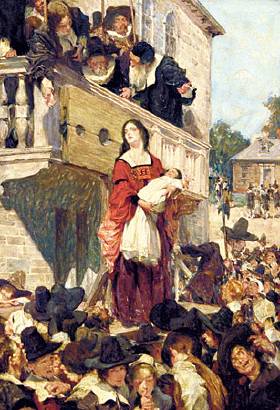
The International Authors edition of The Scarlet Letter

Nathaniel
Hawthorne (1804-1864) was
an American short story writer and novelist. Known for sophisticated allegorical
and moralistic tales often set in New England, he was the first American author
to produce a uniquely American epic, The
Scarlet Letter, a work that sets the pattern for the Great American Novel, a
thematic form built upon a post-Calvinist worldview that intermingles an ironic
appreciation for human individualism with a determined commitment to political liberty
and intellectual freedom. Herman Melville’s Moby-Dick
and Mark Twain’s The Adventures of
Huckleberry Finn are heirs to Hawthorne’s revelation.
A classic of literary art and intellectual history, The Scarlet Letter
represents a definitive formulation of the classic liberal ideas that
mark the emergence of the modern world. Like the Declaration of
Independence, The Scarlet Letter
stands on the shoulders of well-evolved political and theological
discussions advancing a range of related notions concerning human
nature, individualism, community, open public disclosure, the “real”
authority of law, separation of government institutions and powers, and
the separation of church and state. Featuring a penetrating afterword by
Carter Kaplan, the International Authors edition of The Scarlet Letter is intended for students and scholars seeking to cultivate a deep appreciation for Hawthorne's genius and art.
Click here (or the cover image) to purchase.Saturday, June 23, 2012
Friday, June 15, 2012
Sunday, May 13, 2012
John Locke's Place in Intellectual History
It is the doctrine of toleration
rather than the scientific epistemology of An
Essay on Human Understanding (1693) that is Locke’s signal contribution to
modern philosophy. Ill-informed and culpable voices in intellectual history have erroneously
placed the Essay at the center of
Locke’s thought. Locke—as well as the
actual measurable influence of his ideas on the way we live in the modern
world—does not place this importance on the
Essay, and from the time of Bishop Berkeley to the present day the Essay has been falsely elevated within
Locke’s oeuvre so as to deflect
attention from Locke’s central contributions. Beginning with Bishop Berkeley,
this practice has in some instances been the opening move in clearing the way
philosophically for constructing various illiberal and repressive political
systems that are supposedly based on more accurate “scientific” foundations
than Locke’s skeptical epistemology. Locke has thus been identified as part of
a larger Enlightenment straw man that is the target of those seeking to advance
the authoritarian agenda of Continental philosophy, which as a program, in
anthropological terms, seems to be the logical systemic outcome of an
increasingly corporate, nihilistic and authoritarian Academy. To put the story
straight, An Essay on Human Understanding
is Locke’s commonplace book, a record of tentative speculations. It is not his
philosophy but rather an exercise in the method
of his philosophy, and in this method conviviality, measured skepticism and unhurried
consensus are as important as the progression of his epistemological propositions.
The Essay serves Locke’s higher
project to bring people together. Locke’s thinking on the subjects of religious
toleration and social and political diversification represent the actual center
of his philosophy. This philosophy was published in his Letter on Toleration (1689) and Two
Treatises of Government (1690). The doctrines of tolerance and the
diversification of powers that are elaborated in these documents are clearly
based upon the same fundamentals of religious toleration and republican democracy
negotiated among the Independents and the sectaries during the English Civil
War. John Locke’s father, it should be remembered, was an officer under
Cromwell. As well, the patronage of the Earl of Shaftesbury is additionally
illustrative of the connection between the Good Old Cause and Locke’s theology
and politics.
.png)
Monday, April 23, 2012
Professor Hodges on Robert Wickenheiser and the Williamsburg Circle
International Authors editor Jeffery Hodges has written some interesting blog entires on matters of interest to the highbrow community: first, Dr. Wickenheiser's recent talk on collecting Milton; second, a related piece in which Jeffery explores his vision for the Williamsburg Circle of International Arts and Letters.
Wednesday, April 11, 2012
April 14-15: Paradise Lost Collectors' Weekend and Williamsburg Circle of International Arts & Letters Dinner
135 Broadway, Brooklyn, NY 11211
(718) 486-6012
Paradise Lost Collectors Weekend:
Antiquarian Books and Art Exhibit
April 14th Schedule:
2 PM: Dr. Robert J. Wickenheiser, major collector of Milton's Paradise Lost books, art and related materials will talk on an exhibit of items from his collections.
6 PM: The Williamsburg Circle of International Arts and Letters Annual Dinner and Open Meeting in the Grand Reception Hall, gorgeously replete with old master paintings and historic displays.

April 14 & 15, 2012
Featuring the Annual Williamsburg Circle of International
Arts & Letters Dinner
Arts & Letters Dinner
1-2 PM: Paradise Lost Art Early Buying - Many artists proofs, drawings, ephemera of Terrance Lindall's work on Paradise Lost spanning 30 years, plus contemporary Paradise Lost art by other fine artists.
2 PM: Dr. Robert J. Wickenheiser, major collector of Milton's Paradise Lost books, art and related materials will talk on an exhibit of items from his collections.
6 PM: The Williamsburg Circle of International Arts and Letters Annual Dinner and Open Meeting in the Grand Reception Hall, gorgeously replete with old master paintings and historic displays.
Subscribe to:
Posts (Atom)