
"An die Arbeit", Oskar Nerlinger, 1930 (tempera on canvas)
I read this book incorrectly, and I am happy to say so. I began by skimming through the pages, looking for poetry that was visually attractive, and this naturally brought me to those poems of an experimental nature: superpositioned parallel stanzas, sloping formations affecting the “progressions” of some speaker’s conceptualization, organized groupings of “innocuous” typeface… The most elaborate of these successful efforts is the curiously titled “Circularization of Condensed Conventional Straight-line Word-image Structures (Radial-planographic Condenses Word-image structures, Rotation about a Point)”. Notwithstanding what some readers may call the “self-conscious excesses” of the title, the production is intelligently and intelligibly structured—the presentation of a minimalist travel narrative progressing across chronological, historical, and conceptual dimensions; moreover, illustrated with radial diagrams demonstrating the configurations of these multi-dimensional progressions. Another experimental poem intriguingly titled “For Richard Kostelanetz” is (at this point in my investigation) unintelligible, but it remains formally inviting and, evidently, the product of a strict discipline and method. No doubt meanings will emerge upon further study; indeed, it is a “museum instillation” readers will want to repeatedly visit and consider, and discuss with other visitors.
After exhausting the overtly (that is, visually) experimental pieces, I turned to the front of the book and read through the poems that are more recognizably “conventional”. I discovered many more conceptual pieces, but also I was delighted to meet Butterworth’s gentle sensibility. Using few words, Butterworth can evoke a strong sense of voice, narrative, and the “feel” of emotional observations—which are thoughtful and measured. The effect is immersive. The book does what I require most from a book of poetry: it puts me in a "quiet sanctuary" where I can sit, feel stillness, think carefully about the ephemeral nature of words and emotions.
The collection is divided into six chronological sections that reflect stages in Butterworth’s life: 1965-1968, 1968-1975, 1975-1979, 1979-1989, 1989-2001, 2001-2020. This is perhaps the most sensible way to arrange the pieces, but throughout the author’s career, the gentle voice is centrally present. This voice is the true organizing principle, whatever he does. The author has led a life with many challenges, conflicts and losses, but—and maybe curiously—throughout these many disappointments and setbacks, Butterworth’s poetry sustains a quiet place of thoughtfulness, gentle response, and stillness.
At the front of the book are an Introduction (by critic and poet Jim
Burns) and a Preface by the author. Burns properly underscores the author’s
versatility, the terrific range of experiences and techniques that Butterworth
employs—his craft, his attention to detail.
The author’s Preface introduces the chronological sections, elaborating
on many conflicted family situations, on-edge escapades, business successes and
failures (Butterworth was a publisher, and he ran several bookstores in
Manchester), arrests, courtroom dramas, and political conflicts. Also,
Butterworth was one of the many aspiring idealistic writers who gathered with
Michael Moorcock and pursued the British New Wave. J. G. Ballard (the
visionary), Brian Aldiss (the Oxbridge intellectual) and Moorcock himself (the
tireless tribal chieftain, guitar slinger, and typewriter Fagin) are popularly (and
properly) the stars of the New Wave, but it was young writers like Butterworth
who produced the truly exquisite gems of innovation that are the legacy of this
characteristically 1960s movement. And how forward-seeing that movement was! Butterworth’s
biography is fascinating, and it reveals the grist for Butterworth’s poetic
mill. Remarkably, as I’ve already
described, the madcap character of this biographical material is absent from
the thoughtful and quiet poems that this life inspired. I read the opening introductory
pages last, happily.
To view the Amazon description, please click the cover image:


Whitnel Cotton Mills, North Carolina, USA 1908. "...children on night shift going to work at 6 PM on a cold dark December night. The work shift lasts all night, 12 hours. They do not come out again until 6:00 AM." (Photo, Lewis Wickes Hine).
Please click HERE for more images.
Richard Kostelanetz presents essays on art, literature, culture, institutions, politics...
Please click HERE.

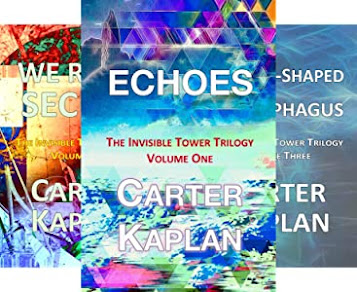
A curious theme in We Reign Secure—Book 2 of the Invisible Tower Trilogy—is a figurative but also sometimes dramatized debate over the question: “Is Satan the hero of Paradise Lost?” The debate becomes very involved, both as a phenomenon of plot development and subtextual theme—and, indeed, with geopolitical implications. In The Sky-Shaped Sarcophagus, Book 3, Satan (or so he calls himself) also plays a role.
It isn’t a spoiler to say the “good guys” in the trilogy do not think Satan is the hero of Paradise Lost.
More broadly, the Satan-as-hero reading of the poem reflects the Gnostic heresy that characterizes the technocrat and transhumanist clans that are the “bad guys” in the trilogy, as well reflecting the Weltanschauung of the “luminaries” in a variety of contemporary real-world conversations.
We might ask ourselves, is Milton’s Satan a globalist and/or a transhumanist?
Deeper still: from time to time in Paradise Lost, is not Milton at some pains to present himself as a man with strong similarities to the Satan he has created?
Reviewing a list of the biographical and psychological comparisons of Milton to Satan in PL would be rewarding, with the caveat that Milton is engaged in an assessment of his own emotions and acts in this regard, and he is on track to correct his errors, especially when it comes to good and effective politics.
Germaine to my purposes in the Invisible Tower Trilogy, the question of Satan’s supposed “heroism” serves to underscore the ethical/political distinction I draw between the two characters engaged in the debate: Eddie Allan the “mastermind” of the Invisible Tower, and his step-father John Allan the technocrat with “Gnostic” and “Satanic” proclivities. Critics should properly read parallels between Eddie Allan and John Allan in the trilogy, and, respectively, Edgar Allan Poe and his step-father John Allan in the history of American literature
But once more to the question of the “hero” of Paradise Lost:
Allow me to share my impression of the philosophical trajectory that moves from Milton to John Locke. For the nonce, let’s assume that Satan is an exponent of “bad politics,” while the Son is an exponent of “good politics.” I think it follows that John Locke is the formulation of the political posture, method and system to which Milton is pointing. And, indeed, not only does Locke refine Milton’s political ideas into usable forms and institutions, but students following Locke’s biography (see Roger Woolhouse) will be impressed with Locke’s ability to get along with people, and even when surrounded, as he was at Oxford, by people who were watching him very very carefully (Locke’s father fought for Cromwell, Locke was no Anglican, and so on). If you want to achieve a revolution and properly install (as Aristotle advises) the middle classes into the legislative and magisterial offices, you follow the Son and not the fallen angel, not the narcissist, not the liar, not the Gnostic, and so on. And, as a coda to this, I endorse Peter Lastlett’s (I think) observation that in assessing Locke’s philosophy, one should begin with A Letter Concerning Toleration. Indeed, the spirit of collegiality, of tolerance and of the free exchange of ideas promoted in this short book is central also to Locke’s An Essay on Human Understanding—is central to the genial spirit of free and open inquiry that is modern skeptical-empirical science; and, moreover, is central to the politics of Classic Liberalism, as presented in Locke’s Two Treatises of Government.
These are but several of the many philosophical threads that animate the trilogy. |
| Michael shows Adam things to come, PL Book XI |
Although Wittgenstein is central to many themes and is "operative" as I approach the construction of narratives, I have hesitated writing about the place of analytic philosophy in the Invisible Tower Trilogy. I have been experiencing some difficulty in arriving at the language to describe these dynamics, but now here it is:
The trilogy presents forceful comparisons among philosophical and theological credulity, conceptual confusion, grammatical confusion, psychological dysfunction, institutional corruption, existential doubt, and the "nature" of narrative--especially in regard to suspension of disbelief and verisimilitude.For the nonce, that shall suffice.
Please click the image to view the Amazon description of the trilogy:

McLuhan's remark is a point of departure for all manner of stimulating literary activity, from semiotics to satire, from poststructuralism to classic liberalism, from continental ideology to analytic philosophy, from institutional misinformation to Judeo-Christian insight, from conceptual credulity to verisimilitude and the suspension of disbelief...
Please click the image to view the Amazon description of the The Invisible Tower Trilogy:

Film by Paul Forshaw & Gareth Jackson, filmed at The Castlefield Gallery
Michael Butterworth Complete Poems 1965-2020
Within a contemporary art vernacular characterized by “context collapse," Paul Mogensen has a achieved a renaissance in abstract painting through the careful exercise of the various ordering principles he uses to achieve his paintings.
Please click HERE for the article and more images.
As Michael Brennan suggests, it looks like a fascinating show. Until I actually see the paintings, this is the piece I find most interesting. Perhaps not because it illustrates Mogensen's inquiring into linearity, or his clever suggestions of the colors and weave of Pomo Indian baskets, but because of the subtle chromatic effects I see variously emerging and progressing as my eye moves down the image.
 |
Paul Mogensen, no title, 1969, alkyd enamel on
unprimed canvas, 82 × 83⅝ inches |

time is no longer
distance is no obstacle
warp factor zero

studio monster
move lights above telling wires
is the illusion?

substance asserts form
life, moment, reality
hoo, hoo, hoo, hoo, hoo


